Massachusetts Bay Transportation Authority - 'MBTA'
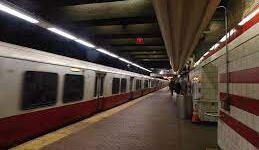
To report crime on the T (MBTA), download the app “MBTA SEESAY"
Service Alerts - Schedules - Maps - Links
MBTA Customer Support &Transit Police Links
Information & Support - Main: 617-222-3200
Transit Police: 617-222-1212
To submit a neighborhood story or event, please fill out this form with a brief description and corresponding links.

BOSTON WATER & SEWER COMMISSION DESIGNATION FOR PARCEL REDEVELOPMENT EXPIRES
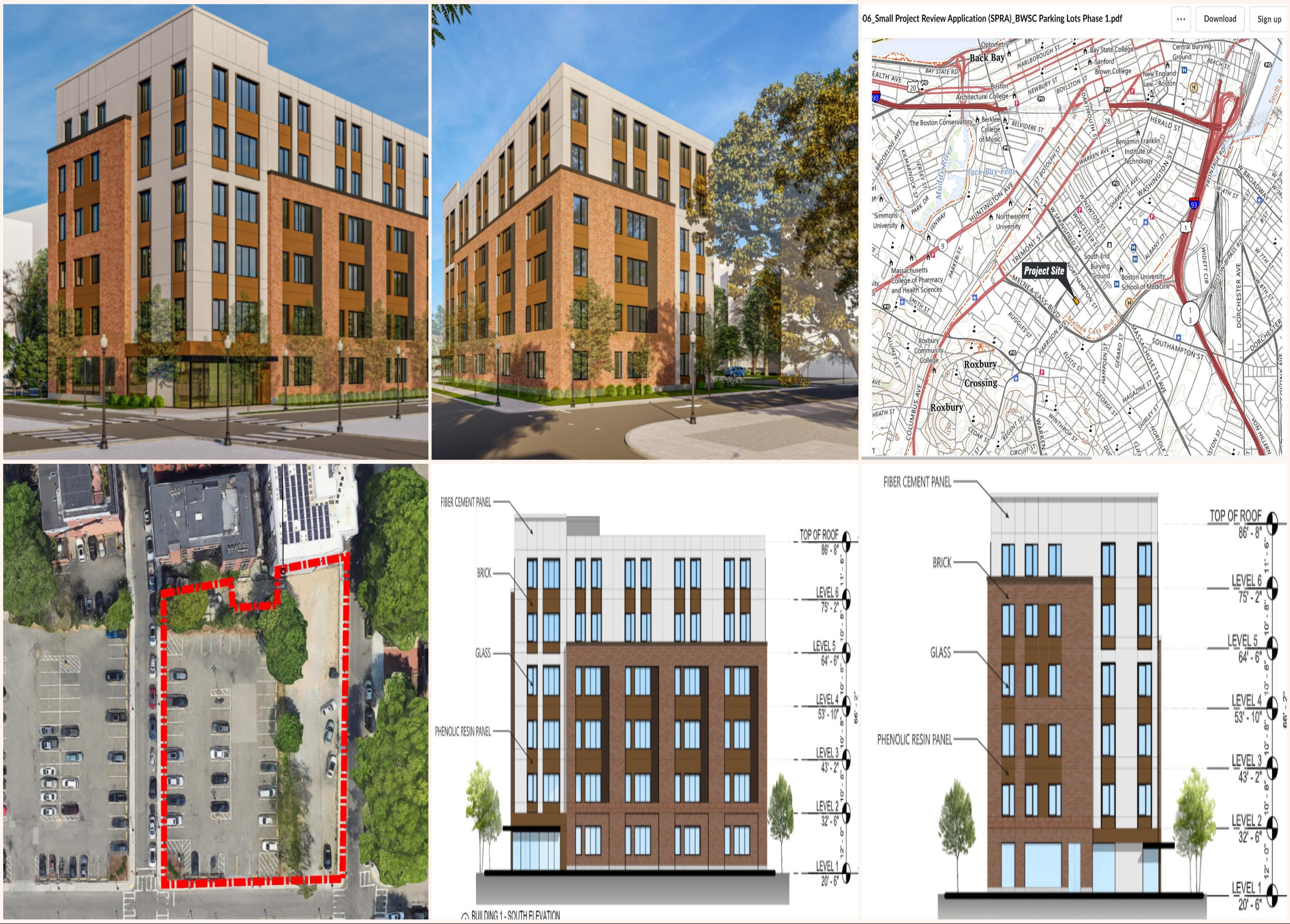
The Boston Planning and Development Agency received two proposals for the long- term ground lease and the redevelopment of the Boston Water and Sewer Parking Lots on February 28th, 2024: Bidders: Related Beal & DREAM Development, and Madison Park Development Corporation Beacon Communities LLC & Jonathan Garland Enterprises, with the Related Beal & DREAM Development proposal for the BWSC Parking Spaces Phase 1 being approved on October 10, 2024. [the tentative designation expired on 10/31/2025]The RFP process and selection resulted in extensive collaboration with the Project Review Committee, the Roxbury Neighborhood Council, and Elected Officials. On February 28, 2024, Harrison Lenox LLC, a joint venture between Related Beal, and DREAM Development, (collectively, the “Proponent”), responded to the RFP, presenting plans to redevelop the existing parking lots to deliver affordable and workforce housing and provide creative solutions for homeownership for families, and seniors.The BPDA awarded a tentative designation to the Proponent for the redevelopment of the BWSC parcels and a handful of associated, small BPDA-owned parcels at the April 11, 2024, BPDA Board Meeting. The BPDA Board Memo outlined that the BWSC parcels (ID: 0801854010 and 0801846000) associated with the land area necessary to deliver Building 1 (“Phase 1”) would be transferred on or before July 1, 2024 with the remainder of the parcels to be transferred by 2030.
The Project Site is surrounded by Newcomb Street to the West, Reed Street to the South, and E Lenox Street to the East, sitting at a critical intersection of Roxbury and the South End.BOARD APPROVED 24 - DOCUMENT NO. 8173
Phase 1 was to benefit from federal American Rescue Plan Act (“ARPA”) funds that must be designated by year-end 2024. The future phases, including more than one acre of public open space and buildings 2-5 as planned in the Proponent’s response to the RFP, will be designed and permitted at a later date, following a land transfer from BWSC to the BPDA. The total development cost was approximately $27,000,000.DESCRIPTION AND PROGRAM:
The Proponent proposes to develop a residential building with approximately 44,000 square feet of Gross Floor Area (“GFA”). The six-story (6) residential building was to contain approximately forty-five (45) affordable homeownership units, fifty-four
(54) bicycle parking spaces, and up to thirty-two (32) at-grade vehicular parking spaces provided in a temporary parking lot associated with Phase 1 of a five-phase project.DEVELOPMENT TEAM:Both DREAM Development and Related Beal are heavily vested in Boston's communities.DREAM DEVELOPMENT AND ITS AFFILIATED FOUNDATION ENGAGE IN SEVERAL INITIATIVES TO SUPPORT AND EMPOWER LOCAL RESIDENTS:
. Dream Community Foundation: Founded with a $25 million seed contribution from employees, this foundation focuses on three pillars:
. Eat Together: Improving food security and using food to foster community bonding.
. Play Together: Supporting arts, cultural celebrations, sports, and summer camps (e.g., Camp Weston, which provides no-cost summer activities for children).
. Grow Together: Offering resources like mentorship, scholarships, and career development.RELATED BEAL:
Related Beal is recognized for its "community-first" development approach, prioritizing local needs through large-scale charitable fundraising and the creation of inclusive public spaces. They actively participate in neighborhood life by hosting cultural celebrations, sponsoring youth STEM programs, and partnering with local non-profits to ensure their projects—like the artist-focused housing and climate-resilient parks in South Boston {our home base]—directly benefit the people living there.SBB has had the pleasure of attending many events which Related Beal facilitated or contributed to. We are grateful for the many community events that we have personally come together with the Related Beal team. Kudos to: Aisha Miller - Vice President, Brian Radomski - Senior Vice President, Construction, Alex Provost - Vice President, Development; {sorry to those we missed} we express our deepest gratitude for your unwavering dedication and support, especially when it comes to our elder population. Your presence in our neighborhood goes far beyond development; you have become a true partner in fostering the vibrant, inclusive spirit that makes South Boston home.DEVELOPMENT PROPONENT: HARRISON LENOX LLCConsisting of: Related Beal, DREAM Development, John Barros - investor and partner, Conan Harris & Associates (CHA) - strategic partner and consultant. The proponent was awarded a "tentative designation" by the Boston Planning & Development Agency (BPDA) in April 2024 to redevelop the Boston Water and Sewer Commission (BWSC) parking lots in Roxbury.The involvement of Conan Harris and his firm was centered on community engagement, diversity-equity-inclusion (DEI), and was charged with the task of ensuring the project aligned with the Roxbury Strategic Master Plan. As part of the DREAM Development and Related Beal team, Conan Harris & Associates handled several critical functions of the proposal:Community Engagement Lead: CHA was responsible for managing the dialogue between the developers and the Roxbury community. This includes ensuring that the voices of local residents, especially those in the nearby Harrison-Lenox area, are heard and reflected in the project's design and programming. A core part of the CHA mandate was to ensure the project meets or exceeds the City's goals for minority- and women-owned business (M/WBE) participation. Harris leveraged his background in city government to navigate workforce development and local hiring initiatives.The proposal included a unique "Wealth Building Program" designed to help renters in the new development, to eventually transition into first-time homebuyers within the same project. Harris’s firm was instrumental in shaping these social-equity components. CHA was charged to ensure the proposal adheres to PLAN: Nubian Square and the Roxbury Strategic Master Plan, acting as a bridge between the technical requirements of the Planning Department (formerly BPDA) and the socio-economic goals of the neighborhood.SBB STORYLINE:"The city of Boston's redevelopment plans [BWSC Parcels] for a significant architectural and social pivot in the Roxbury neighborhood have been taken off the table. For decades, a collection of sixteen parcels totaling approximately 191,528 square feet has served primarily as the mundane backdrop for employee and visitor parking for the Boston Water and Sewer Commission (BWSC). However, a comprehensive Request for Proposals (RFP) issued by the Boston Planning & Development Agency (BPDA) signaled a new era for these vacant lands. This initiative was aimed to transform underutilized parking lots into a vibrant, mixed-use community hub that prioritizes housing affordability, wealth creation, and local economic resilience.The transformation of the Boston Water and Sewer Commission (BWSC) parking lots represented more than just a typical urban infill project; it is a meticulously timed attempt to leverage federal resources for generational wealth. According to addenda and project guidelines, the Boston Planning & Development Agency (BPDA) and the Mayor’s Office of Housing (MOH) were not merely looking for buildings, but for a "Phase 1" catalyst that can navigate a very narrow window of federal opportunity. This redevelopment was tethered to the American Rescue Plan Act (ARPA), which dictated a rigid financial tempo: funds were to be obligated by December 2024 and completely spent by December 2026. This created a high-pressure environment where administrative milestones, such as securing Article 80 Board Approval by November 2024 and building permits by August 2025, were non-negotiable prerequisites for success.To meet these aggressive federal deadlines, the BPDA had issued a specific strategic recommendation for the proponent. The agency suggested focusing the initial phase of development on the northwest grouping of parcels located at East Lenox Street and Reed Street. By designating this specific area for "Phase 1" affordable homeownership, the city had hoped to streamline the complex Article 80 review process, and ensure that the most time-sensitive funding was utilized effectively. While the $20 million pool of ARPA funds was to be shared among three different sites across the city, the level of subsidy for the BWSC lots would depend on the strength and scope of the developer’s objectives. This phasing was not just about logistics; it was a design challenge to ensure that the initial homeownership units remained cohesive with the larger, long-term vision for the rest of the site.Central to this RFP was a radical rethinking of how low- and moderate-income residents access the housing market. Proponents were required to detail a "rent-to-own" programmatic element that allows participants to transition from renters to owners within a defined timeframe. [typically five years]. This was not a simple lease agreement but rather a comprehensive financial structure. The developer was to use language as to how participants would accumulate savings or build equity over time, providing a safety net for those whose incomes might fluctuate monthly. Furthermore, the plan was to include robust safeguards to ensure that residents were not blindsided by significant cost increases once they transitioned to full ownership. This included the establishment of maintenance reserves, and clear terms on how the final purchase price and interest rates would be determined.To support these aspiring homeowners, the city mandated a partnership with HUD-approved agencies to provide intensive financial counseling. This went beyond basic credit building; it involved a schedule of regular counseling sessions designed to prepare residents for the long-term responsibilities of cooperative or condominium ownership. The goal was to create a predictable financial environment where unanticipated costs were to be managed through dedicated funding mechanisms, ensuring that the transition to homeownership was sustainable rather than a temporary milestone.The path to breaking ground involved a rigorous regulatory gauntlet, primarily governed by the City of Boston Planning Department, Article 80 review process. This process officially began once the selected development team submitted a "Project Notification Form", the groundwork for a proposal such as this starts much earlier of course. The BPDA had introduced a Project Review Committee (PRC) to serve as a community-based advisory body. This committee, composed of local residents, having no beneficial connection to the developers would act as the gatekeeper for community interests. They were to evaluate submissions based on visioning sessions and local planning studies, such as the 2019 PLAN: Nubian Square.
The PRC’s role was critical because it had the option to serve in lieu of an Impact Advisory Group (IAG) during the formal Article 80 process. This ensured that the people most affected by the redevelopment have a seat at the table from the initial RFP review through to the final Zoning Board decision. For the developer, success in this environment required more than just financial liquidity; it required a demonstrated ability to communicate a vision that satisfied both the city’s technical requirements—such as geotechnical assessments and utility relocations—and the community’s demand for development without displacement.The technical complexity of the BWSC lots could not have been overstated. The proponent was responsible for all site assessments, as the BPDA had not provided a pre-existing geotechnical report. This meant the selected team must be ready to execute surveys, permitting and zoning refusal filings immediately to keep the ARPA timeline alive. The "One Stop" application format remained the standard for financial submissions, requiring a perfect balance between sources and uses. As the city moved toward its April 2024 target for tentative designation, the focus remained on finding a proponent who could manage the many facets of this project: the cold, hard deadlines of federal guidelines, and the human-centric goal of building a more equitable Roxbury.The bedrock of this proposal was a ninety-nine-year ground lease, a structure that allows the city to retain long-term ownership while facilitating private development. The BPDA had established a fair market value of $3.50 per square foot of gross floor area per year. While this served as the benchmark, the agency recognized that the "most highly advantageous" proposal isn't always the one that pays the most cash upfront. Developers are permitted to offer a lower price—even as low as a nominal $100—if they can prove that the discount directly subsidizes significant community benefits like deeply affordable housing, or dedicated community programming spaces. This trade-off must be backed by a credible financial narrative and an as-is appraisal for any private land involved in the assembly.Beyond the base rent, the lease is structured as a Net-Net-Net (NNN) agreement, meaning the developer is responsible for all taxes, utilities, and maintenance. To protect the public interest against inflation and market shifts, the lease was to include three percent annual increases and a market reset provision at specific intervals. Furthermore, the BPDA captures a slice of the project's long-term success through transaction rent, claiming two percent of gross sales prices upon assignment, or two percent of refinancing proceeds. Even individual homeownership units sold without restrictions would contribute back to the agency, ensuring that the public investment in the land continued to yield dividends for the city.The selection process was governed by an "Evaluation Committee" and a "Project Review Committee" (PRC) composed of local residents. Proposals were ranked on a scale from "Highly Advantageous" to "Not Advantageous" across nine distinct criteria. The Diversity and Inclusion Plan carries a massive twenty-five percent weight in the final score, requiring specific strategies for including people of color and women in every phase from pre-development to ongoing operations. A proposal that merely met minimum standards was unlikely to succeed; the city was looking for teams that would exceed affordability requirements and provide "Development Without Displacement" strategies that would help current Roxbury residents remain in their homes.Sustainability was another high-stakes category. To earn a top ranking, a project was to achieve LEED Platinum certifiability and exceed Zero Carbon Building performance targets. There was a specific emphasis on healthy development, which included design strategies meant to mitigate the urban heat island effect. This involved careful selection of materials and site layouts that would reduce the absorption and re-emittance of heat, protecting residents from the rising temperatures of the urban core. The proponent must also demonstrate the financial capacity to execute, providing documented liquid equity, and letters of interest from lenders that match the total development budget.The human element of construction is addressed through the Boston Residents Jobs Policy. Any selected project must meet strict employment quotas: fifty-one percent of total work hours must go to Boston residents, forty percent to people of color, and twelve percent to women. These standards apply to both journey people and apprentices across every trade. The "Good Jobs" standard further evaluates how a developer treats its full-time employees, looking for a comprehensive implementation plan that provides living wages and pathways to economic mobility for the local workforce.Once the developer was granted a "Tentative Designation", a nine-month clock began. During this period, the team was to finalize its financing, complete the Article 80 review process, and obtain all necessary building permits. Final designation—the point at which the land is actually conveyed, would only be granted once every condition of the "One-Stop" application was met and the ground lease was fully negotiated. If the property was not conveyed within the established timeframe, the designation was to be rescinded, ensuring that public land does not sit idle under the control of a team unable to perform. The Planning Dept. reserved the right to negotiate any other terms of the lease to ensure the project remained consistent with community preferences and financial feasibility.While the physical design—the wide sidewalks and green canopies, captured the eye, the true engine of this initiative lied in the rigorous administrative and financial standards set by the Mayor’s Office of Housing (MOH) and the Boston Planning & Development Agency (BPDA). Every dollar invested was subject to a "wealth-creation" lens, shifting the focus from simply housing people to empowering them as stakeholders. This final phase of the draft outlined a world where pro-formas, equity plans, and strict federal timelines converged to create a neighborhood that is both sustainable and self-determined.Securing the future of Roxbury requires a level of financial transparency that goes far beyond standard real estate practice. Proponents who sought city funding must navigate the "One Stop" application process, balancing diverse sources and uses for both commercial and residential components. A critical constraint was the timeline associated with the American Rescue Plan Act (ARPA), which dictated that funds must be obligated by December 2024 and fully spent by December 2026. This urgency forced a phased development approach, where income-restricted units were prioritized to ensure they meet federal deadlines.Cost containment was another pillar of the city’s strategy. To ensure that public subsidies were used efficiently, the MOH had implemented strict caps on soft costs. Architectural and engineering fees, for instance, are tiered based on project size, limited to 5.8 percent for large-scale developments of over 71 units. Legal expenses are similarly restrained, with a median cost cap of approximately $150,000. These measures were set in place to prevent "fee creep" and ensure that the maximum amount of capital is directed toward high-quality materials and deep affordability rather than administrative overhead.Perhaps the most radical departure from traditional development was the weight given to the Diversity, Equity, and Inclusion Plan. This component accounted for a full 25 percent of the comparative evaluation for each proposal. It was not enough to simply hire a diverse workforce; the city was looking for significant and impactful economic participation at every level. This included management roles for people of color and women, as well as ownership stakes for certified Minority-Owned Businesses (MBEs) and Women-Owned Business Enterprises (WBEs).The draft encouraged innovative partnerships like mentor-protégé relationships and joint ventures that build long-term capacity for underrepresented firms. The goal was to ensure that the wealth generated during the pre-development, construction, and operational phases of these buildings stayed within the community. Proponents had to demonstrate a track record of such inclusion, proving that their commitment to diversity is a core business practice rather than a reaction to a mandate.The project area is strategically nestled between Harrison Avenue, Washington Street, East Lenox Street, and Melnea Cass Boulevard, resting at the geographic and cultural seam of the South End and Roxbury. This land carries a complex history, transitioning from 18th-century salt marshes to a 20th-century industrial and residential corridor. Much of the current vacancy is a byproduct of the 1975 General Plan and subsequent urban renewal efforts. By acknowledging this legacy, the BPDA and the Mayor’s Office of Housing (MOH) are not just seeking buildings; they are seeking a restorative development that aligns with the Roxbury Strategic Master Plan and PLAN: Nubian Square.The site’s connectivity is one of its strongest assets. Located within walking distance of the Boston University Medical Campus, and Northeastern University, the property is a transit-oriented goldmine. It is currently served by over ten bus lines, including the Silver Line, making it a pivotal location for residents who rely on the city’s public transportation network to access jobs and services across the Greater Boston area.At the heart of this redevelopment was a radical commitment to housing equity. The BPDA had identified a significant "affordability gap" in the area, noting that nearly 70% of households in the surrounding census tracts earn $50,000 or less annually. To address this, the RFP encouraged a "1/3 model" for housing distribution. This ideal breakdown sought to allocate one-third of units for households earning up to 50% of the Area Median Income (AMI), another third for those between 51% and 70% AMI, and the final third for those above 70% AMI. At a strict minimum, at least 60% of all residential units must be income-restricted.The proposal went beyond traditional rentals by championing wealth-building tools. Community members had expressed a strong desire for "Rent-to-Own" models and alternative pathways to homeownership. These programs are designed to help low- and moderate-income residents—including public housing residents and voucher holders—build equity from their very first rent payment. Furthermore, the RFP placed a heavy emphasis on "family-sized" units with two to four bedrooms and dedicated senior housing, ensuring that the development supported a multi-generational community.To protect these future homeowners, the draft mandated strict affordability guidelines. Monthly housing costs covering principal, interest, taxes, insurance, and condo fees was not to exceed 45 percent of a household’s monthly income. Furthermore, the proponent was required to establish and train condominium boards, ensuring that new owners would be prepared for the logistical and financial responsibilities of self-governance. An emphasis was also placed on eviction prevention, requiring a narrative that details how any "equity" payments would be returned to a resident if they were to leave the program before purchasing their unit.
A unique and poignant feature of this development was the "Selection Preference for Displacees". In a direct effort to mitigate the harm caused by mid-century clearance activities, families and individuals previously displaced from the South End Urban Renewal Project Area was to receive preference during the housing lottery and sales process. This represented a tangible step toward restorative justice, ensuring that those who were pushed out of the neighborhood would have a prioritized path to return.Beyond housing, the ground floor of these future structures was expected to serve as a catalyst for local entrepreneurship. The planning called for "ground floor activation" that would include neighborhood services, retail, and restaurants. There was a specific focus on small business development, with requests for community kitchens, cooperatives, and incubator spaces that would provide local startups with the physical infrastructure they needed to thrive.Given the increasing threats of climate change, the redevelopment must also serve as a bulwark against the "Urban Heat Island" effect. Proponents were expected to integrate resilient and sustainable design elements, including the creation of public open spaces, and healthy development practices. Because the site sits over several BWSC stormwater lines and specific "special structure areas," the engineering would have to be as thoughtful as the social programming.The submission requirements for the physical design were equally demanding, requiring neighborhood plans, schematic floor plans, and eye-level perspective drawings that show the project in its full urban context. The Planning Department is looking for "porosity"—the idea that buildings should feel open and accessible rather than like walled-off fortresses. This is achieved through detailed elevation drawings that specify materials and architectural details that respect the historic row houses on Thorndike Street while introducing a modern, high-quality aesthetic to Melnea Cass Boulevard.The internal street network, featuring Newcomb and Thorndike Streets, would be reimagined to balance the needs of pedestrians, cyclists, and vehicles. This commitment to equitable mobility ensured that the development would not not become an isolated island of luxury, but rather a porous, accessible extension of the existing Roxbury fabric.The process for selecting a developer was rigorous, involving a $5,000 submission fee, and a detailed evaluation by the BPDA and MOH. Proposals were required to be submitted by February 28, 2024, with a heavy emphasis on design, sustainability, and financial feasibility. The selected proponent was responsible for navigating existing zoning of the Boston Zoning Code and coordinating with the BWSC to ensure that the city's utility needs are met during the transition of land ownership.Ultimately, the goal of the submission was to prove to the community that the new development would be a "highly beneficial use" of the property. From the 15-year operating pro-forma to the zero-emissions building assessment, every document is a piece of a larger puzzle aimed at proving that Roxbury can be a model for the rest of the country—a place where environmental resilience, financial ingenuity, and social justice are built into the very foundation of the neighborhood."WHY DID THIS REDEVELOPMENT PROPOSAL FAIL:The decision by the City of Boston - Planning & Development Agency (BPDA) not to extend the Tentative Designation to Dream Development and Related Beal ultimately came at the behest of DREAM Development, stating they could not reach a consensus on a path forward. That the parties involved were unable to reach alignment on a structure that would allow the project to proceed collaboratively. As such DREAM Development formally acknowledged the end of the joint venture, in written correspondence to the city.While the designation officially expired on October 31, 2025, the failure of the proposal was not due to a single event, but rather a combination of shifting infrastructure priorities and missed funding deadlines. A major driver for this project was the use of American Rescue Plan Act (ARPA) federal funds. Federal rules required ARPA funds to be "obligated" (assigned to specific contracts) by the end of 2024 and fully spent by 2026.Because the Dream/Related Beal proposal faced delays in community review and infrastructure planning, it missed critical windows to secure this funding. Without this subsidy, the high level of affordability (89% income-restricted) became financially unfeasible for the developers to maintain.SOCIO- ECONOMIC REASONS:. Financial "Gap" and Market Conditions - The economic landscape of 2024–2025 was particularly harsh for large-scale affordable housing:
. Interest Rates & Construction Costs: High borrowing costs and inflated material prices created a "funding gap" in the Dream/Related Beal proposal.
. Senior Housing Complexity: The proposal included a dedicated 94-unit senior housing component. Senior housing requires specialized subsidies and higher operating costs, which the developers struggled to balance as other costs rose.. A big strike came from Conan Harris and his consulting firm, Conan Harris & Associates (CHA), as part of the development team led by Dream Development and Related BealIn this partnership, Conan Harris & Associates served as a strategic consultant focusing on community engagement, workforce development, and diversity. The firm’s role is to ensure the project aligns with the goals of the Roxbury Strategic Master Plan and PLAN: Nubian Square, specifically regarding equitable growth and wealth creation for local residents. Harris and his team were tasked with facilitating conversations between the developers and the Roxbury community to ensure the project remains community-driven and addresses the specific needs of the neighborhood, such as affordable homeownership and jobs for local contractors.Feedback from the Project Review Committee, the Roxbury Neighborhood Council, and the broader community regarding the workforce development plan presented by Conan Harris & Associates (CHA) and DREAM Development was to be put forward with rigorous expectations for accountability. The committee’s primary focus was ensuring that the "restorative justice" rhetoric of the proposal translated into measurable economic gains for Roxbury residents.Much of the overall plan was based on its adherence to PLAN: Nubian Square and the Roxbury Strategic Master Plan. The feedback centered on three specific pillars:Contractor Diversity and M/WBE Participation: The committee strongly supported the team's commitment to over 50% Minority and Women-Owned Business Enterprise (M/WBE) participation across all phases—design, construction, and management. Feedback from committee members also emphasized that CHA must act as a "watchdog" of sorts to ensure these weren't just targets, but active contracts for local firms.Wealth Building for Residents: A standout feature of the proposal was the "rent-to-own" and homeownership pathways. The committee and residents provided critical feedback that the plan needed to specifically target those displaced by 1970s urban renewal.Job Pipelines vs. Temporary Roles: During public vetting in late 2023 and early 2024, community members and the oversight committee pushed for the workforce plan to include permanent, sustainable careers rather than just temporary construction labor. In response, the CHA plan integrated partnerships with local culinary training and incubator spaces to provide long-term employment on the ground floor of the new buildings.POINTS OF TENSION:Some concerns regarding the proposed social equity goals were raised. Feedback from the committee and local groups like Reclaim Roxbury highlighted concerns about the depth of affordability. The committee pushed the developers to deepen the income restrictions, specifically asking how the workforce plan would help residents at the 0–30% Area Median Income (AMI) bracket, rather than just the "workforce" bracket (up to 120% AMI).The tentative designation for the DREAM Development and Related Beal proposal on the BWSC parking lots missed several milestone markers, some stemming from a misalignment between the team's ambitious social equity goals and the practical, financial, and political realities of the project. While the involvement of Conan Harris & Associates (CHA) was initially praised for its focus on restorative justice and community co-authorship, several factors related to their specific strategy contributed to the proposal’s eventual stall and failure.One significant negative impact was the complexity and cost associated with the workforce and "rent-to-own" programs championed by Harris. CHA’s plan required an unprecedented level of administrative oversight and financial subsidy to ensure that the 402 units reached the lowest levels of Area Median Income (AMI) while simultaneously funding a robust local contractor incubator. As the Boston real estate market faced a downturn in 2025, the high "social cost" of the CHA-led initiatives made the project increasingly unfeasible for the developers to finance without additional city or federal gap funding, which the city was hesitant to provide given the shifting economic climate.Furthermore, the community engagement process led by Harris, created a "policy deadlock" by promising specific outcomes that clashed with citywide zoning reforms. For example, while Harris worked to secure community support through promises of high-density affordable housing, the project faced intense pushback from neighboring groups in the South End. The firm's focus on Roxbury-specific restorative justice sometimes struggled to bridge the gap with these neighboring South End stakeholders, leading to protracted delays in the Article 80 review process.Though the proposed development was approved by the BPDA Board on 10/10/2024 in accordance with Article 80E - Small Project Review, the development team was not able to engage in a workable partnership.This is illustrated in DREAM Development's letter to the City of Boston Planning Department - Rebecca Tomasovic (Hansen), Director of Real Estate dated 10/14/2025: https://drive.google.com/file/d/1hWs8pOP76u5GBeaau4DYwE-sSmh4YC_5/viewDREAM Development - Greg Minott, Managing Principal:"Throughout this period, DREAM has actively engaged all parties—including Related Beal, John Barros, and Conan Harris—in an attempt to reach a consensus on the path forward. We have put forward multiple proposals reflecting a range of possible structures, including both limited and passive roles for certain parties, and have been willing to accept terms that would preserve continuity and minimize delay for the City. Despite these efforts, the parties were unable to reach alignment on astructure that would allow the project to proceed collaboratively.""I regret to report that our efforts to find common ground have not been successful. Accordingly, DREAM is formally acknowledging the end of the joint venture."









































































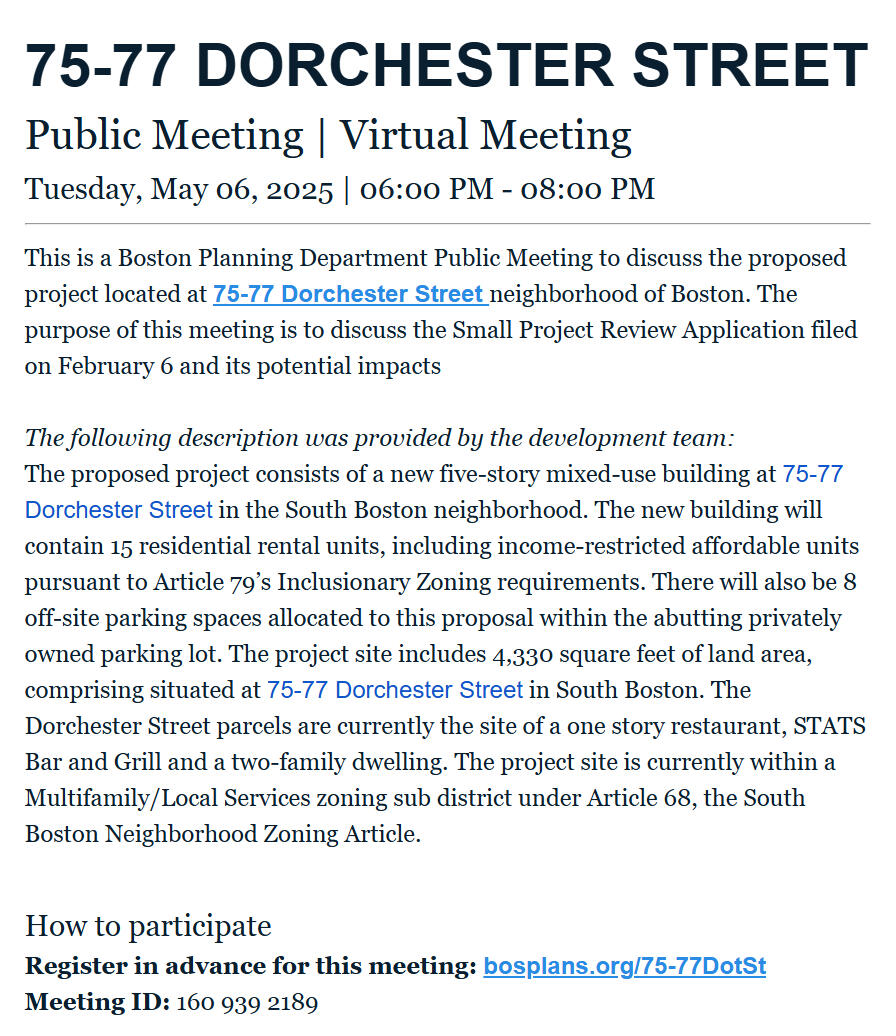
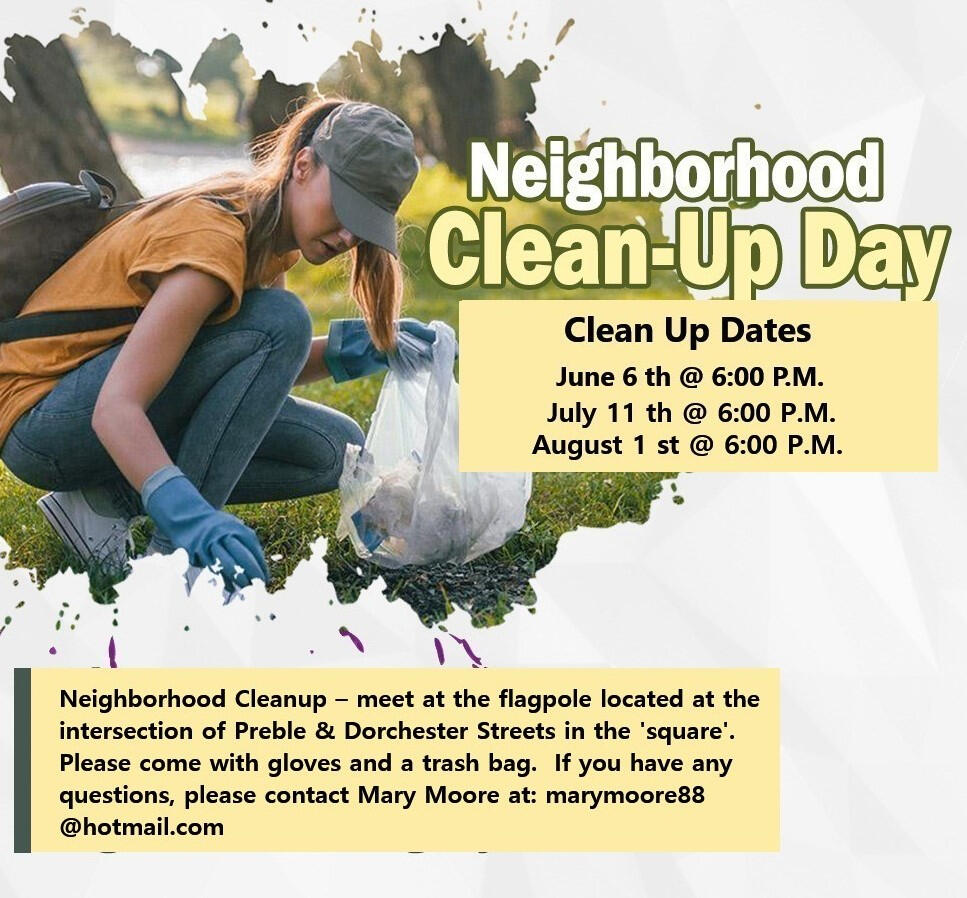
Neighborhood News
Click on an image for story

.

.

.
.

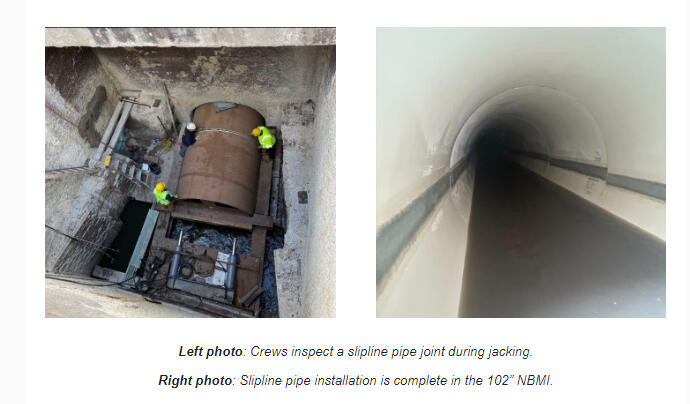
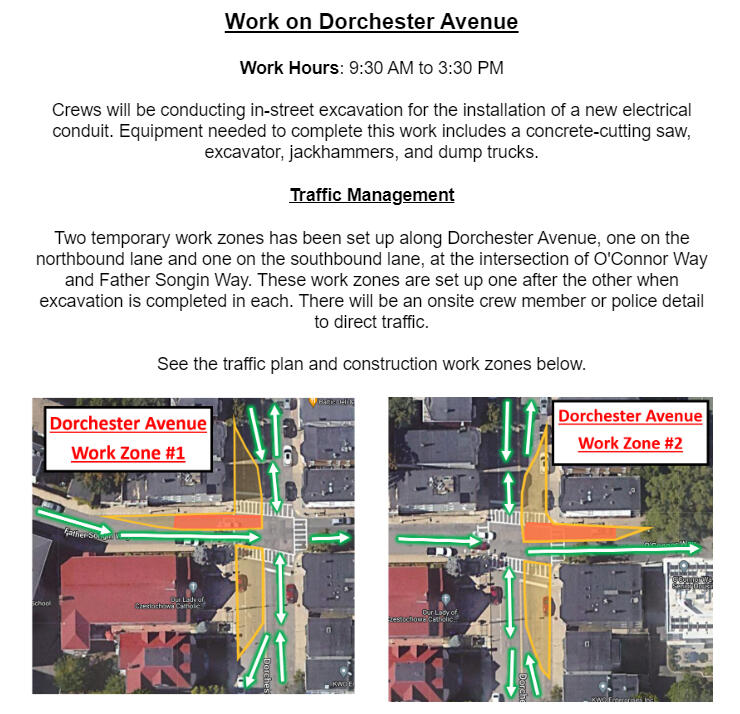
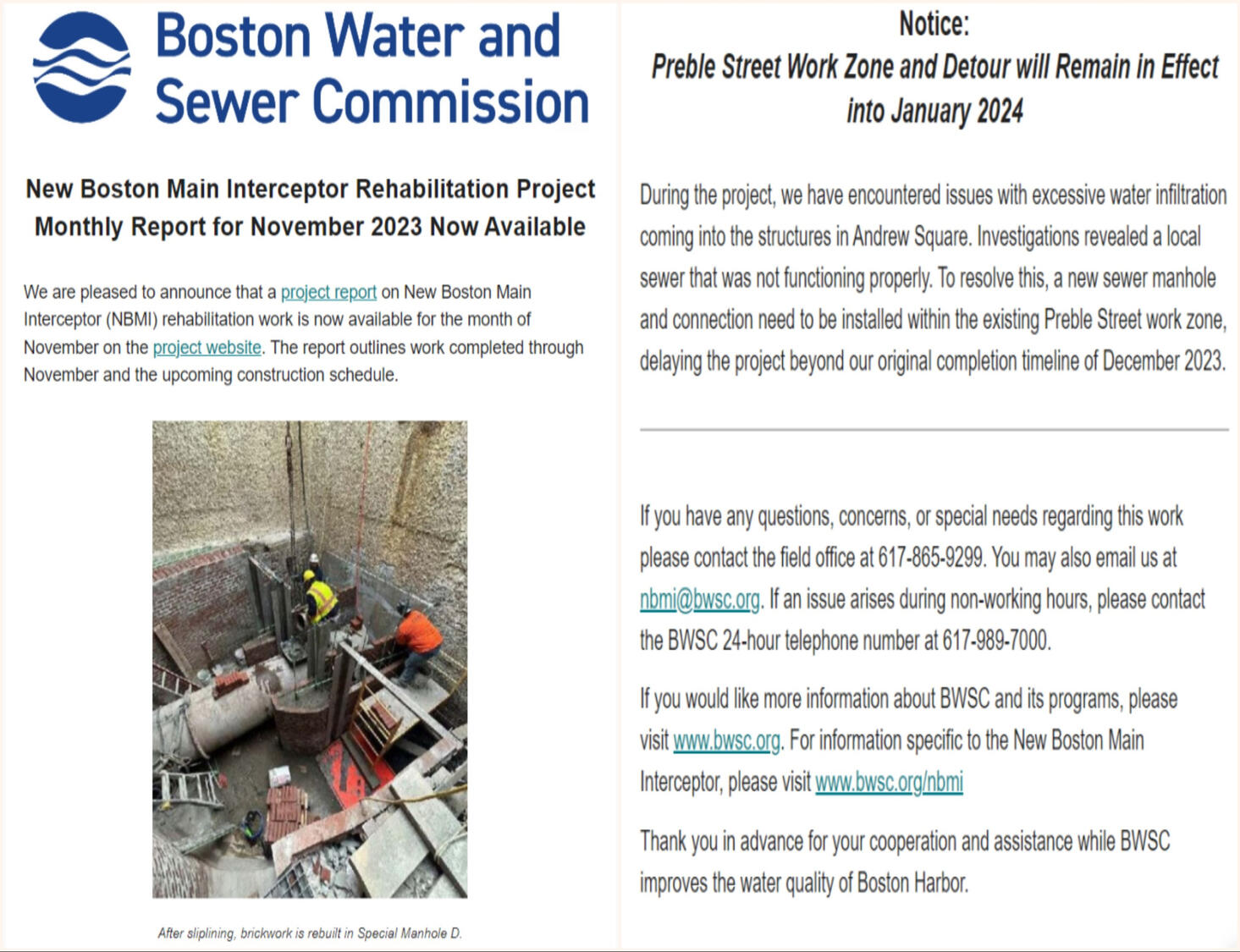
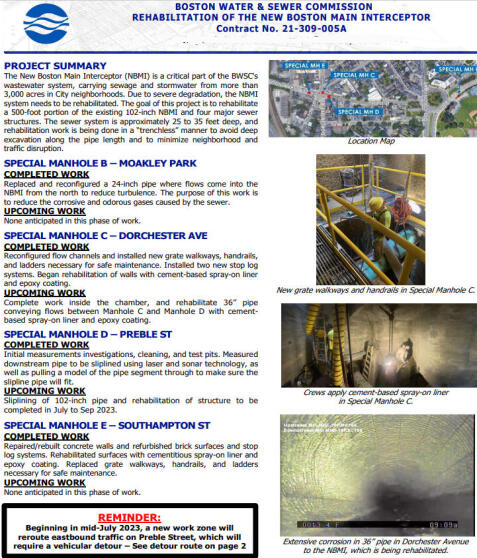
NBMI is a critical part of the wastewater system needing relining.

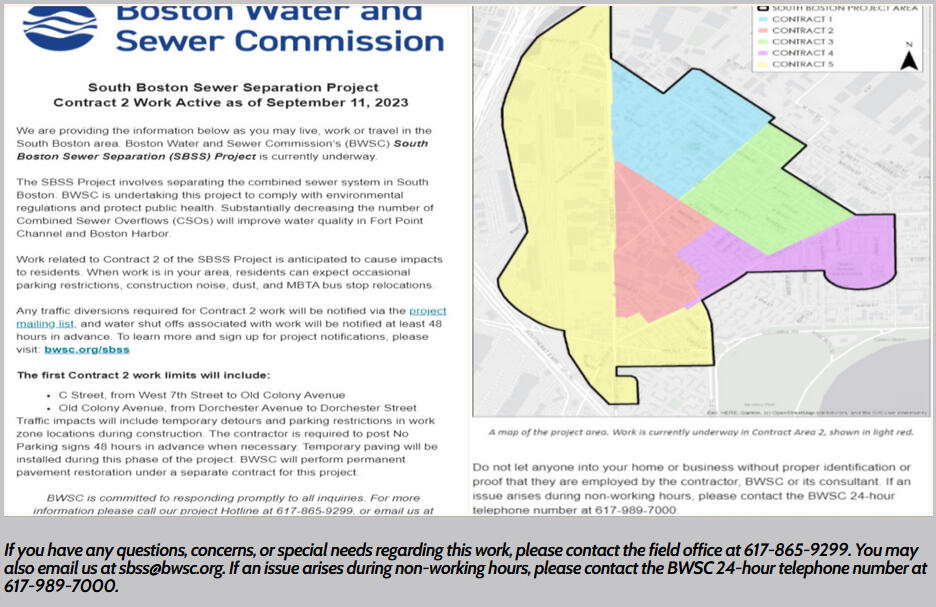
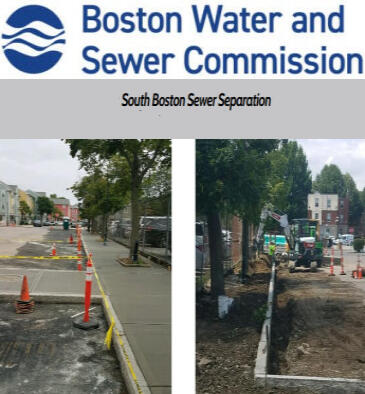
So Boston Sewer Separation Project goal: separate stormwater from the existing sewer system
Development News

Click on an image for info.

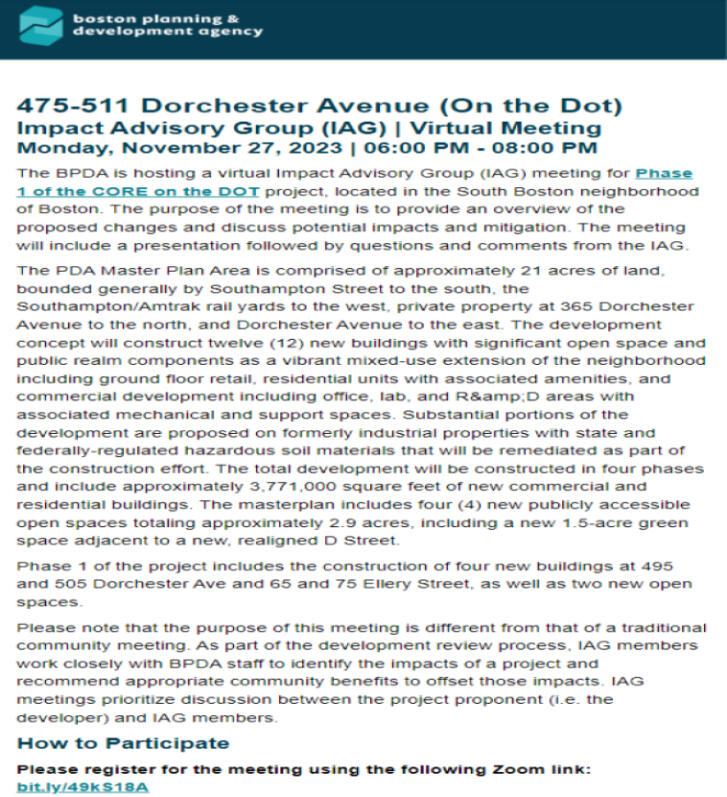
BPDA - On The Dot Phase 1 IAG Meeting 11/27/2023

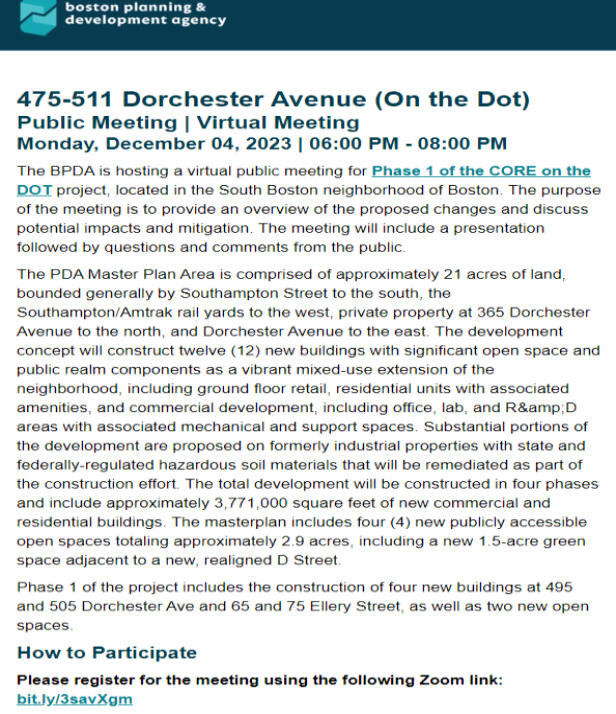
BPDA - On The Dot Phase 1 Public Meeting 12/4/2023

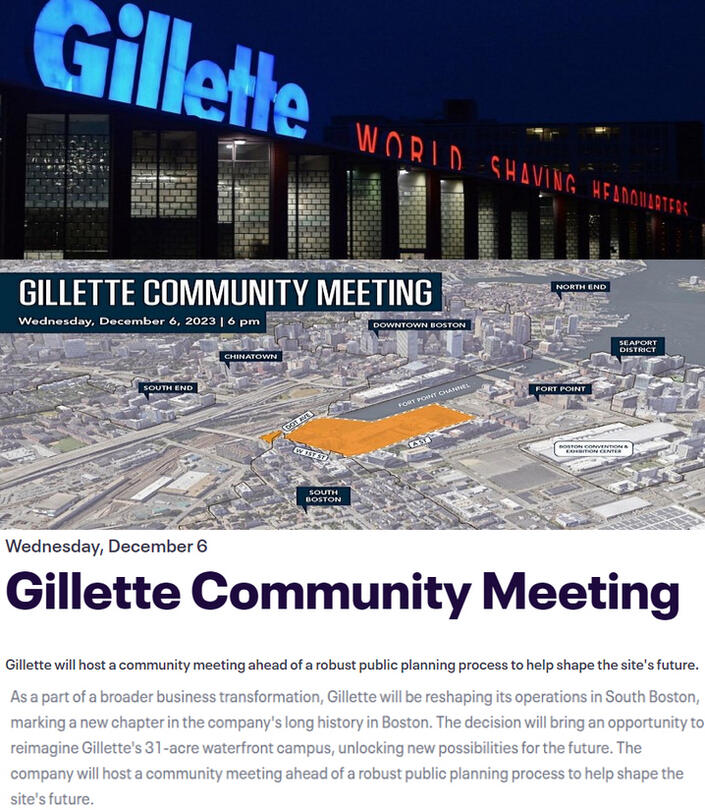
Public planning process to help shape the site's future. 12/6/2023

CANCELLED - 10/30/2023 BPDA Meeting

.

Boston Planing & Development Agency Calendar & Events

.

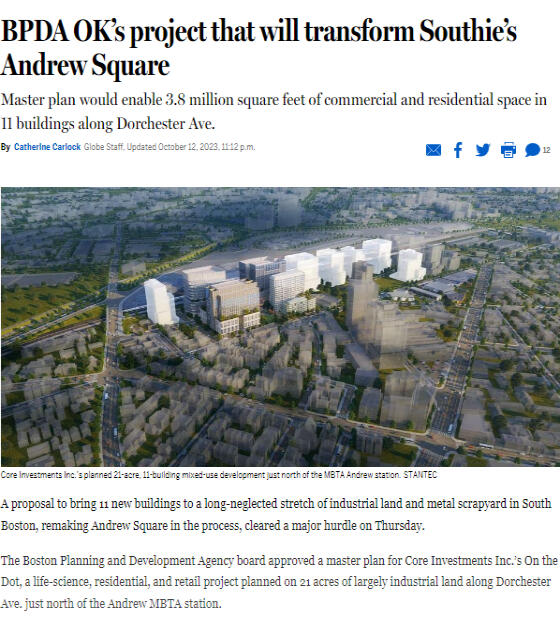
Core Investment's OTD PDA Master Plan receives BPDA approval

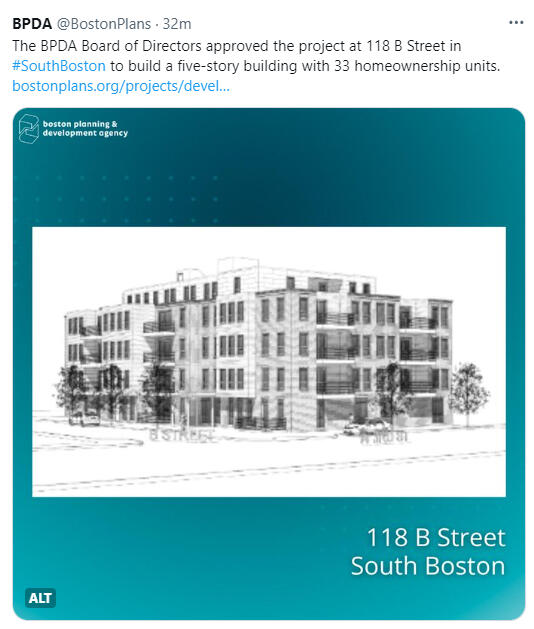
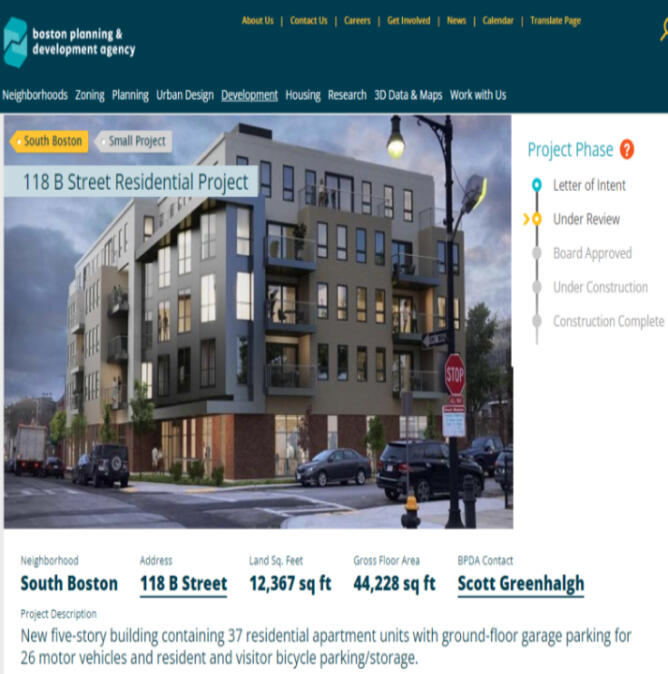
The BPDA Board of Directors approved the project at 118 B Street

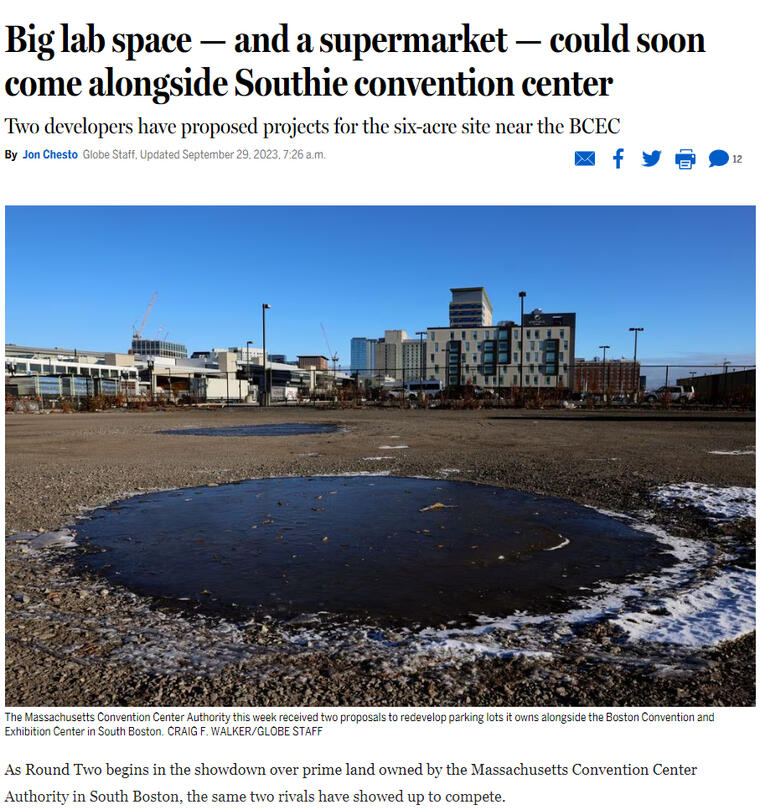
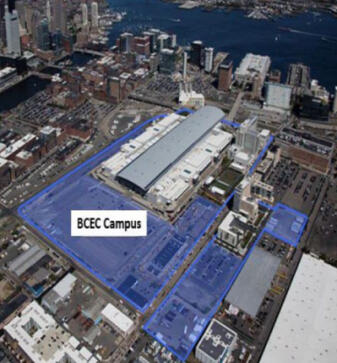
Massachusetts Convention Center Authority land in South Boston proposals.

South Boston Development News: Greyhound Bus Site Trades for $23.5M

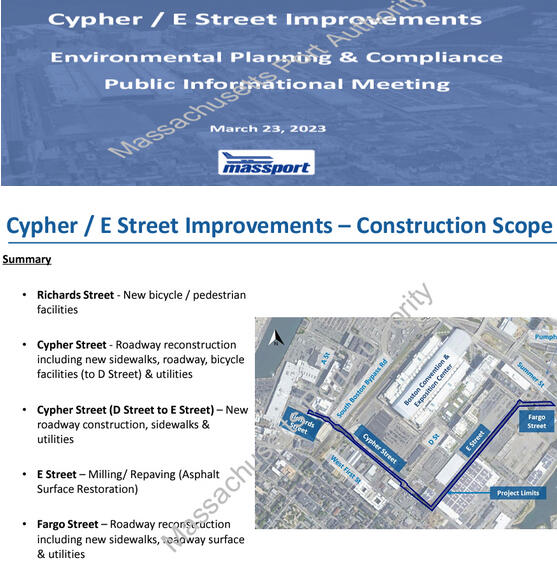
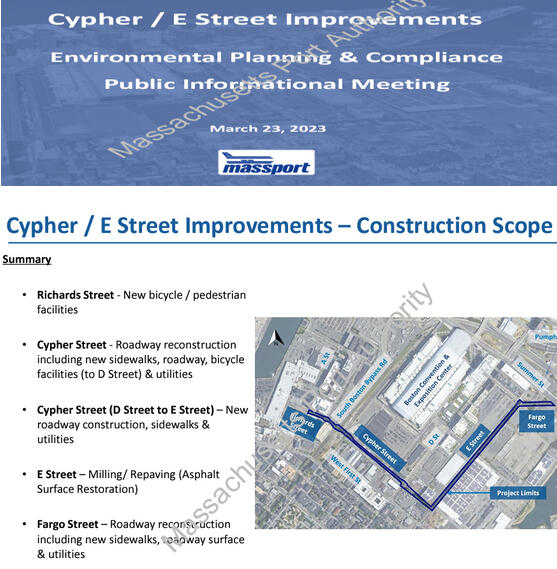
Cypher & E Streets Improvement Project starts September 5th.
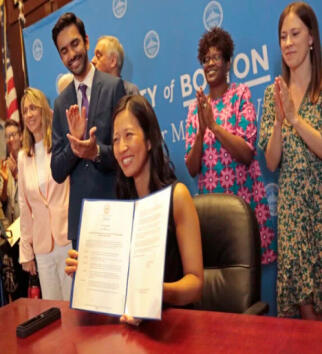
Mayor Wu bans fossil fuels from new municipal buildings and major renovations

The Massachusetts Convention Center Authority scrapped a previous bidding process in April amid community concerns and opposition from elected officials

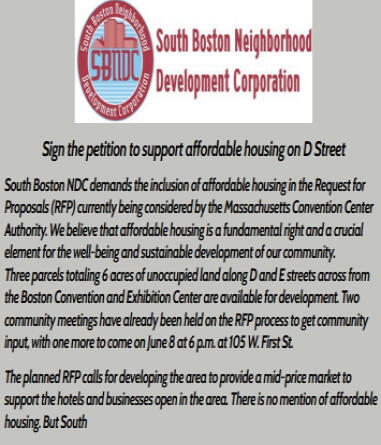
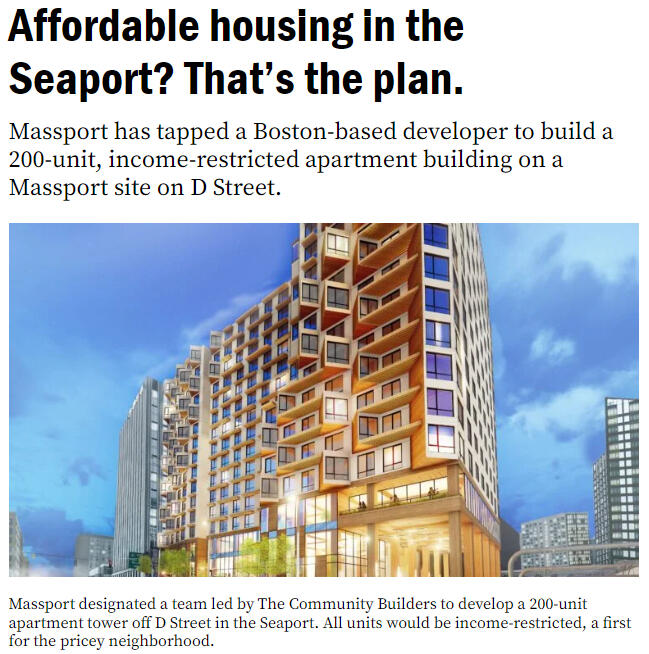
Sign the petition to support affordable housing on D Street

South Boston Sewer Separation work

BWSC - Boston Main Interceptor Rehabilitation Project
Recap Of Neighborhood Meeting Fort Point Neighborhood Association and St Vincent’s Lower End Neighborhood Association

Click on an image for info.

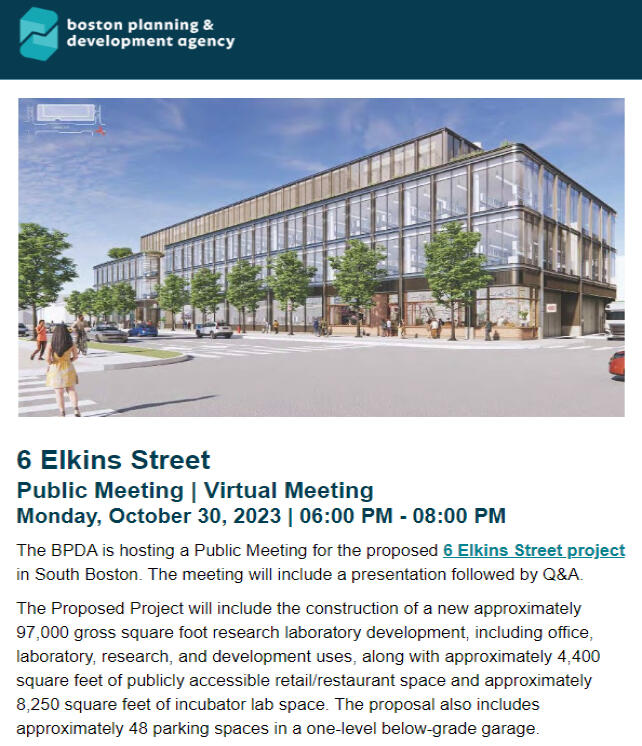
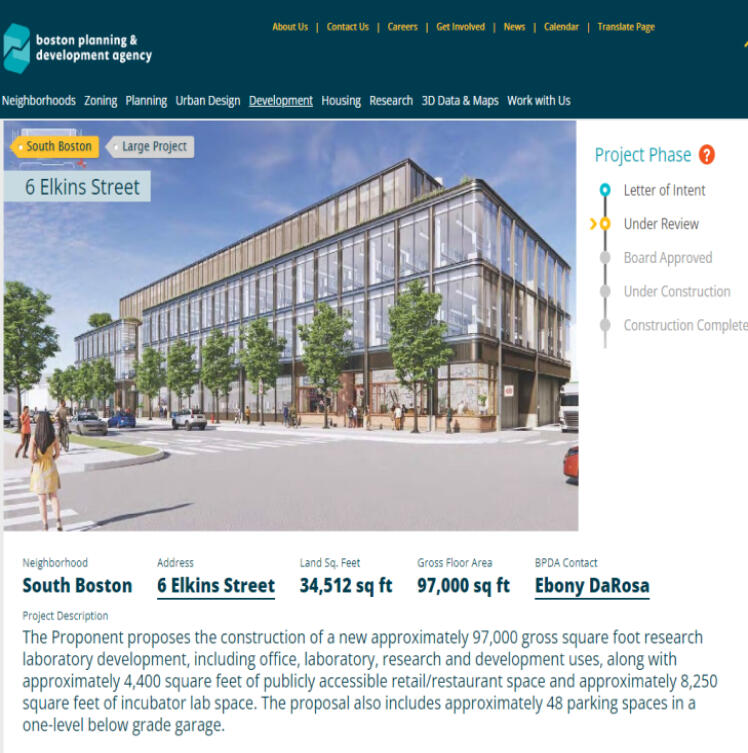
6 Elkins St. IAG Meet 10/2/2023 - Public Meet 10/10/2023

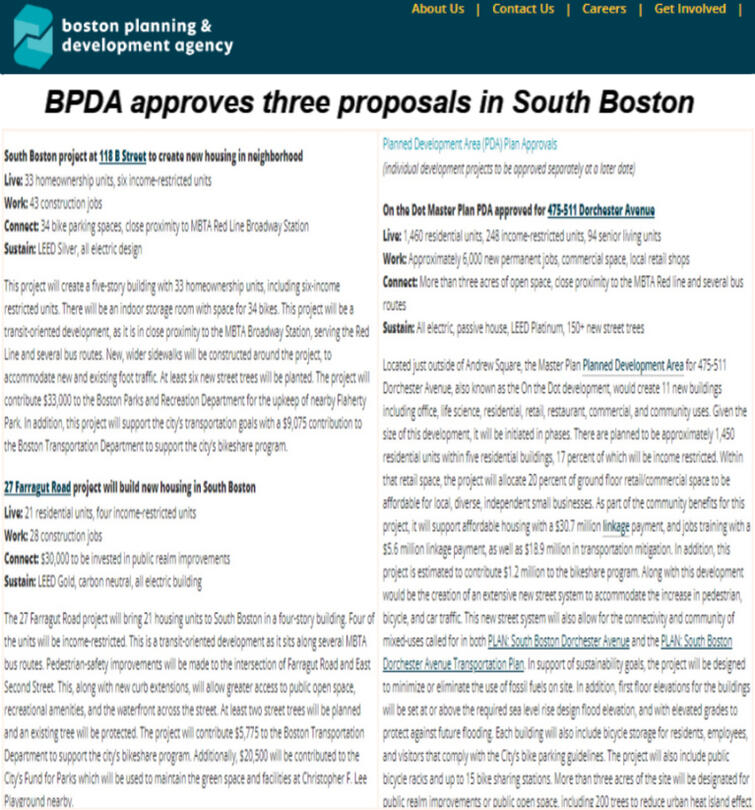
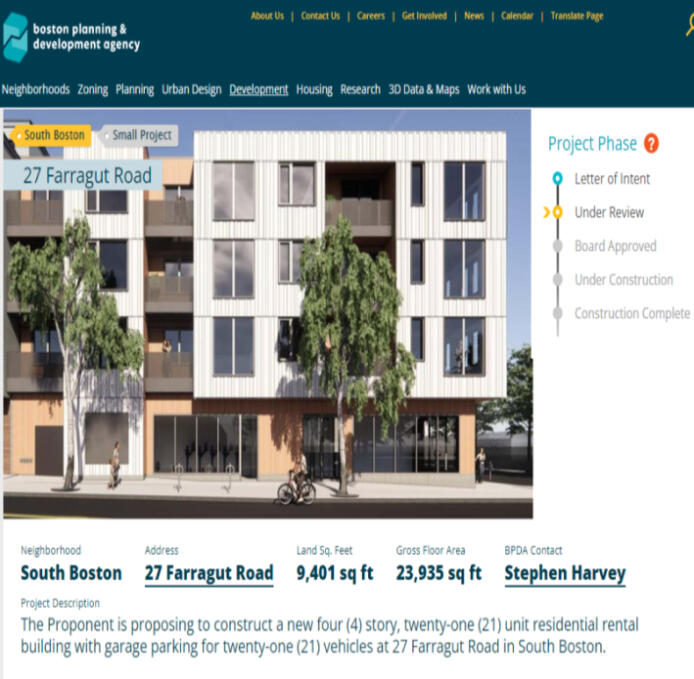
27 Farragut Road

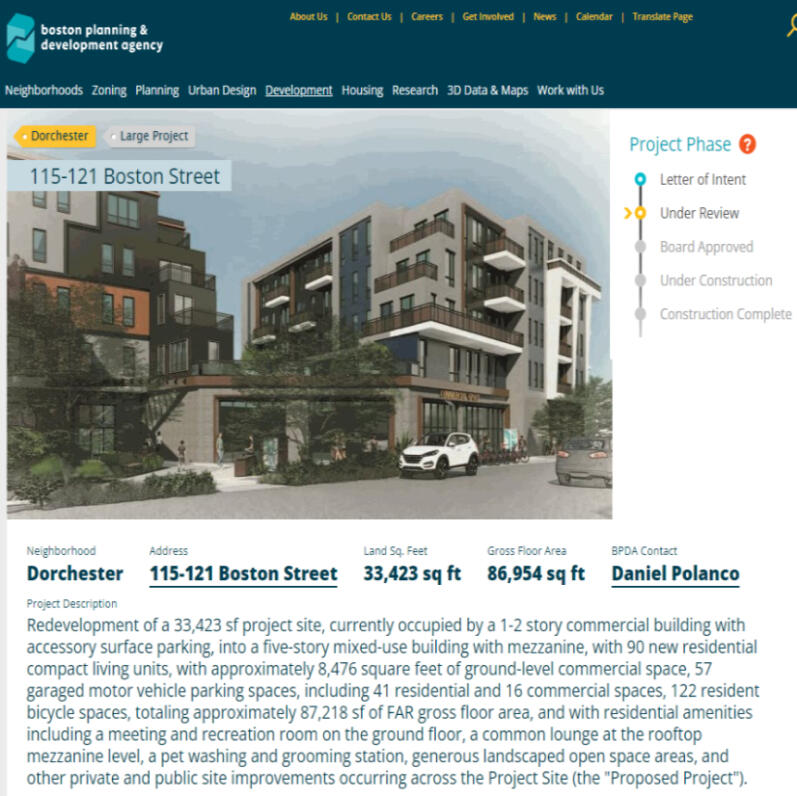
115-121 Boston Street

118 B Street

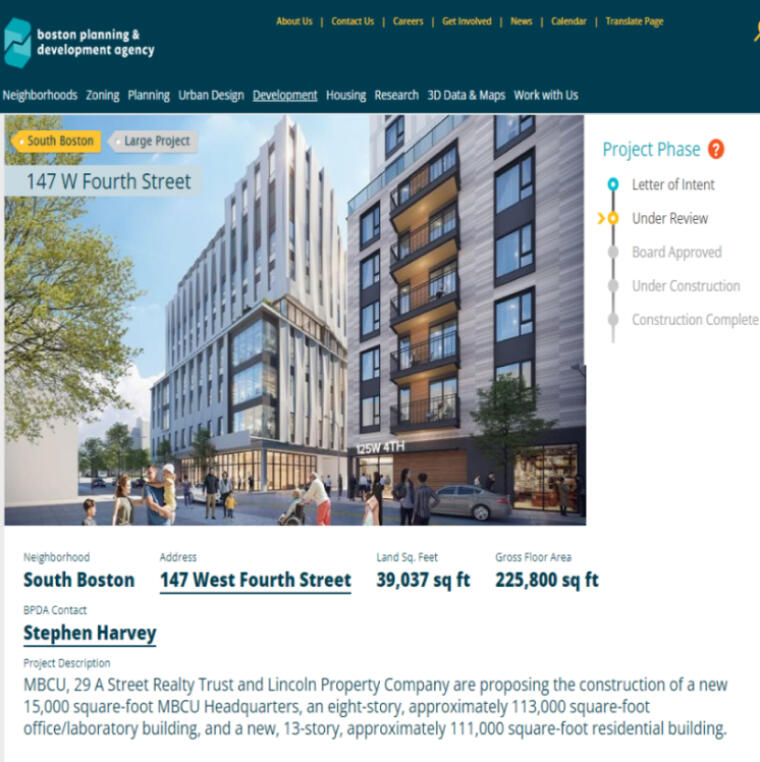
147 W. 4th Street

232 A St. IAG Meeting 9/5/2023

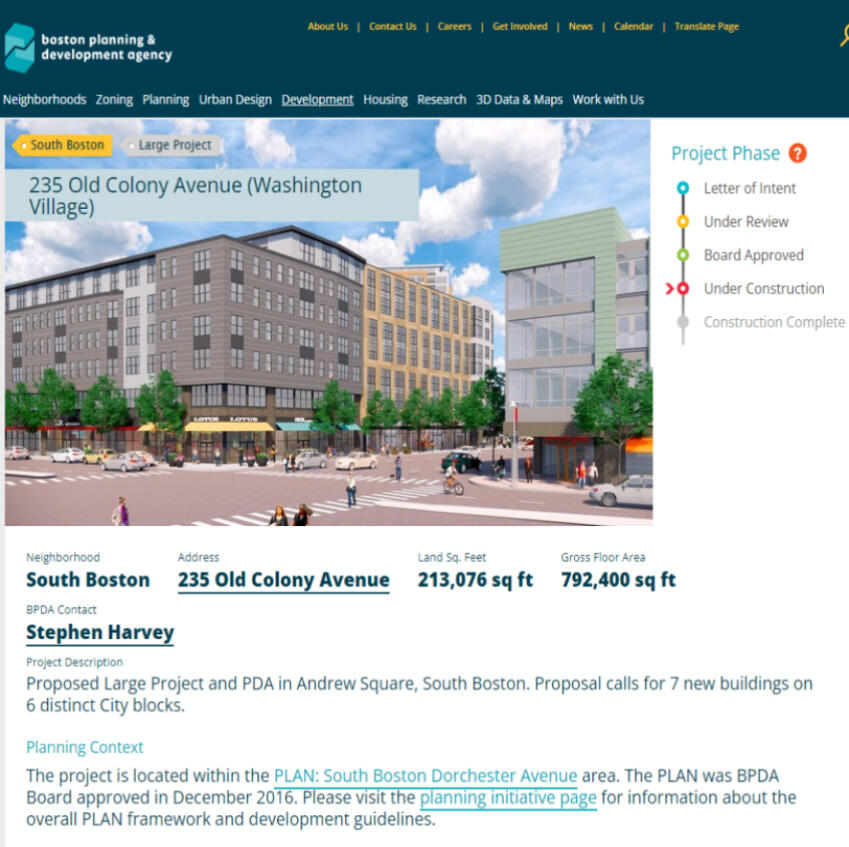
235 Old Colony Ave (Washington Village) - Construction Phase

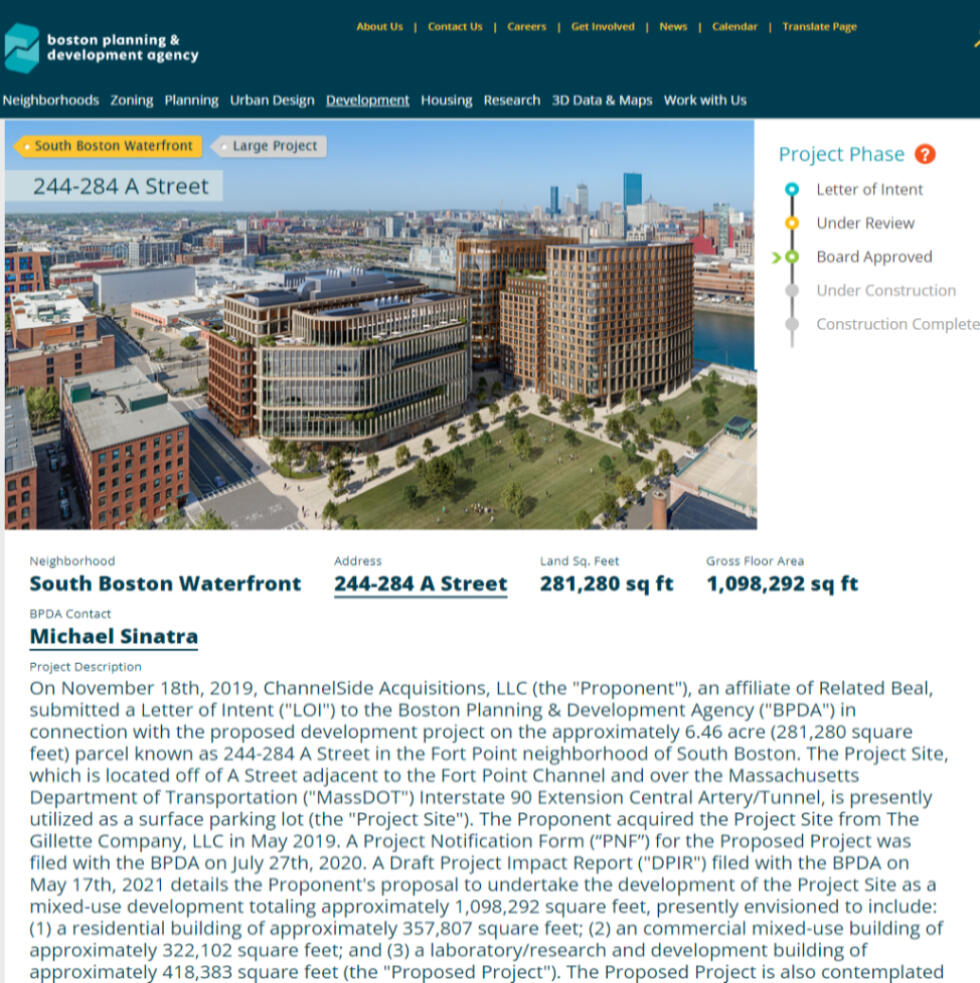
244-284 A St. BPDA approved 10/13/2022

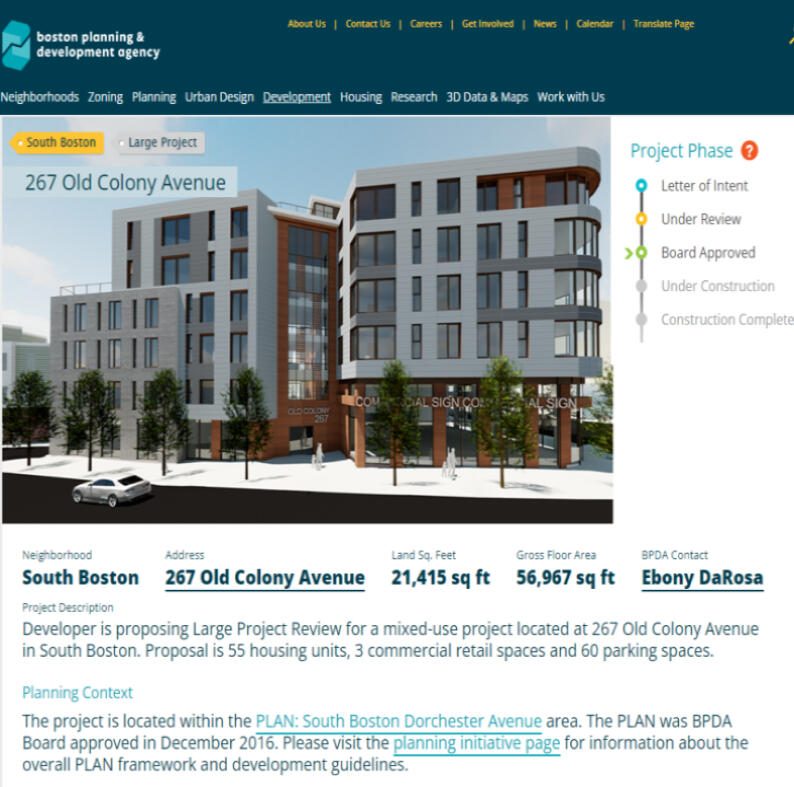
267 Old Colony Ave (Trimount Place) Under construction.
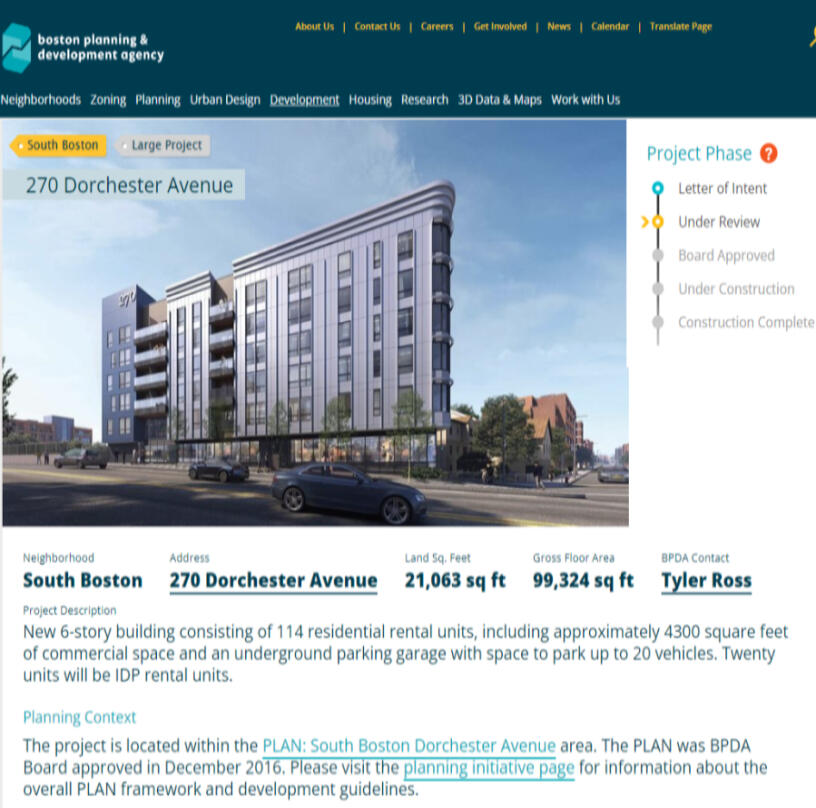
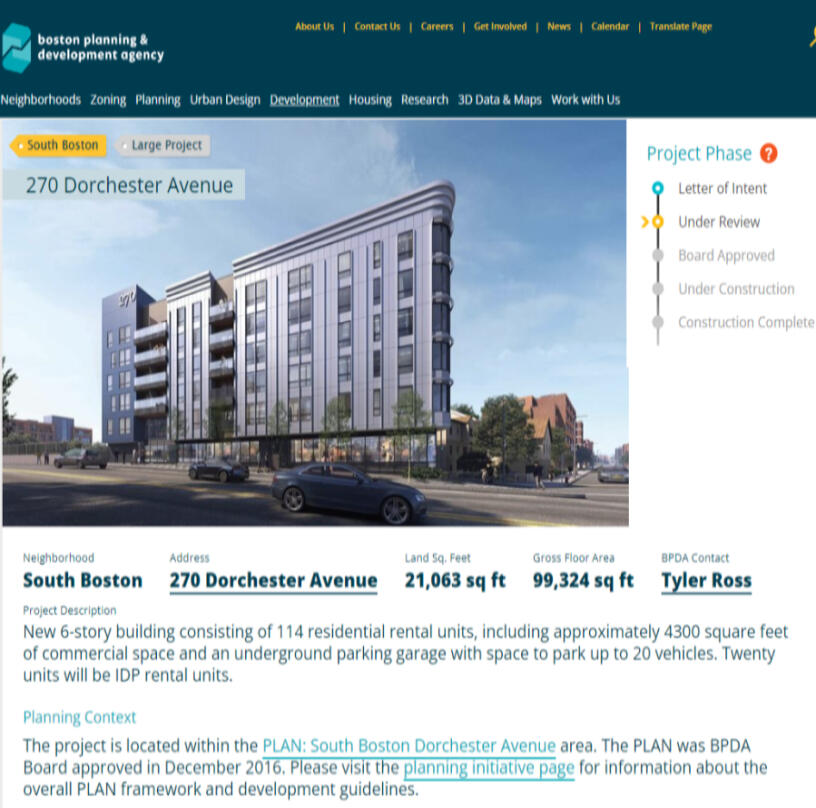
270 Dot Ave - NPC to rentals. 9/19/2023

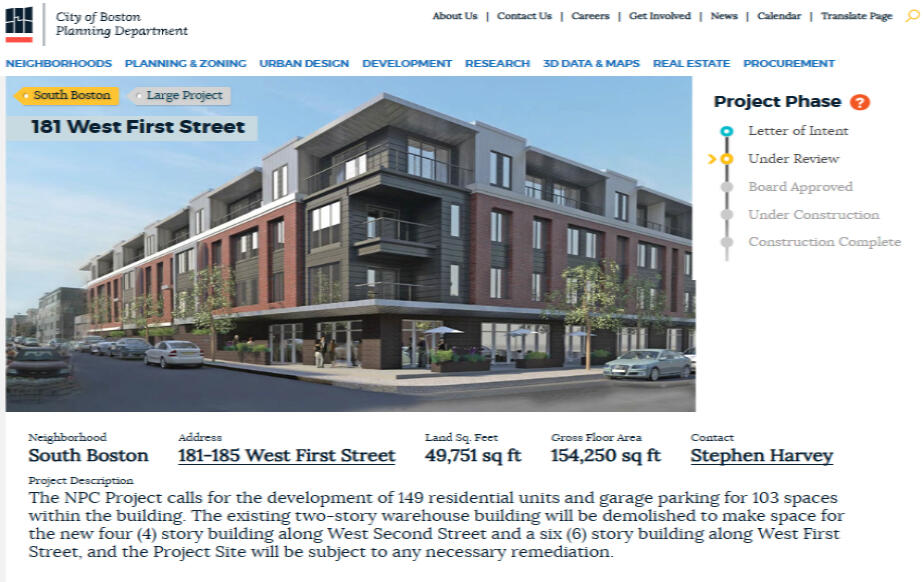
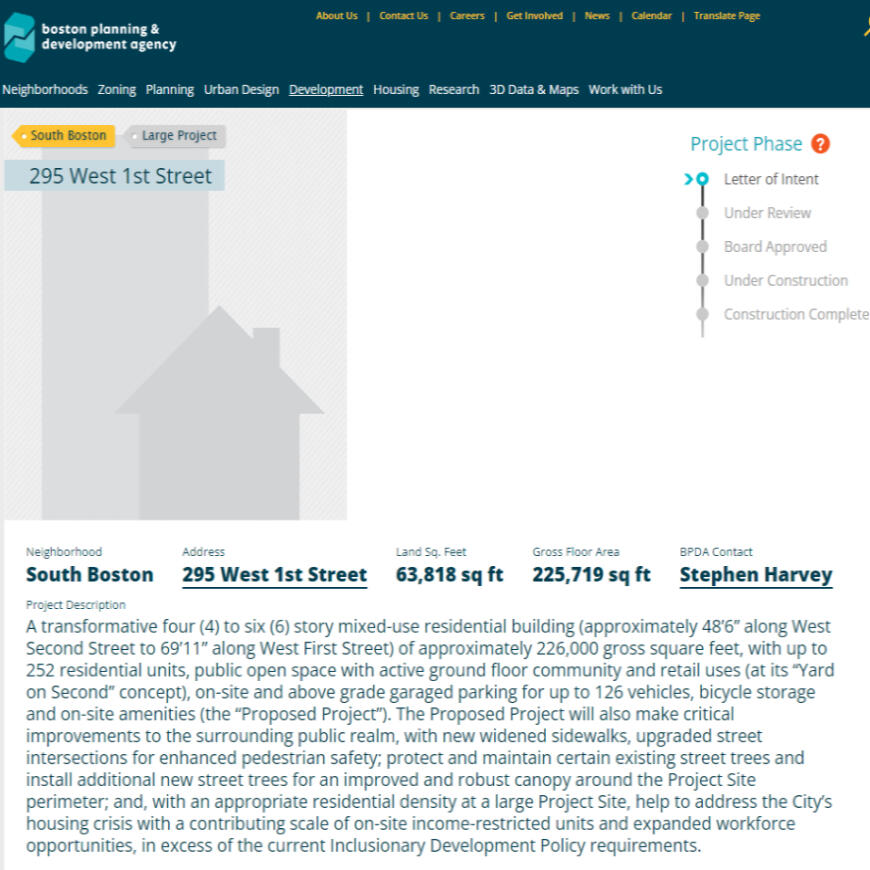
295 West 1st Street

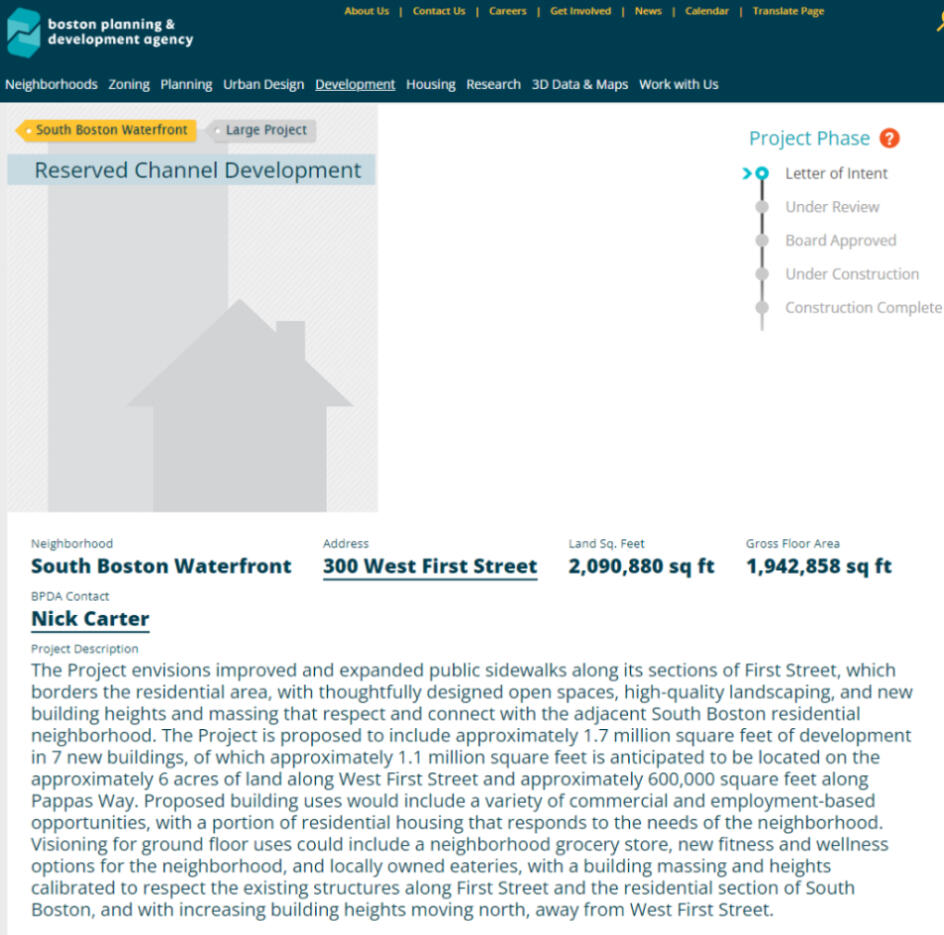
300 West First Street

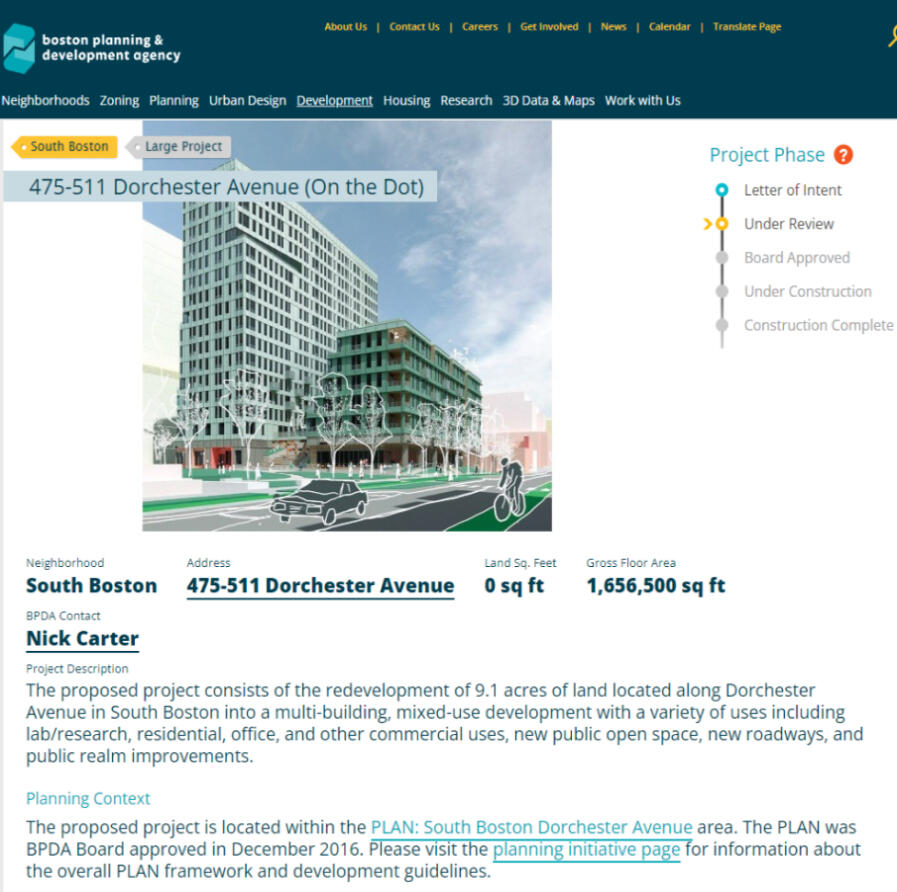
475-511 Dot. Ave. OTD - IAG Meeting 10/2/2023

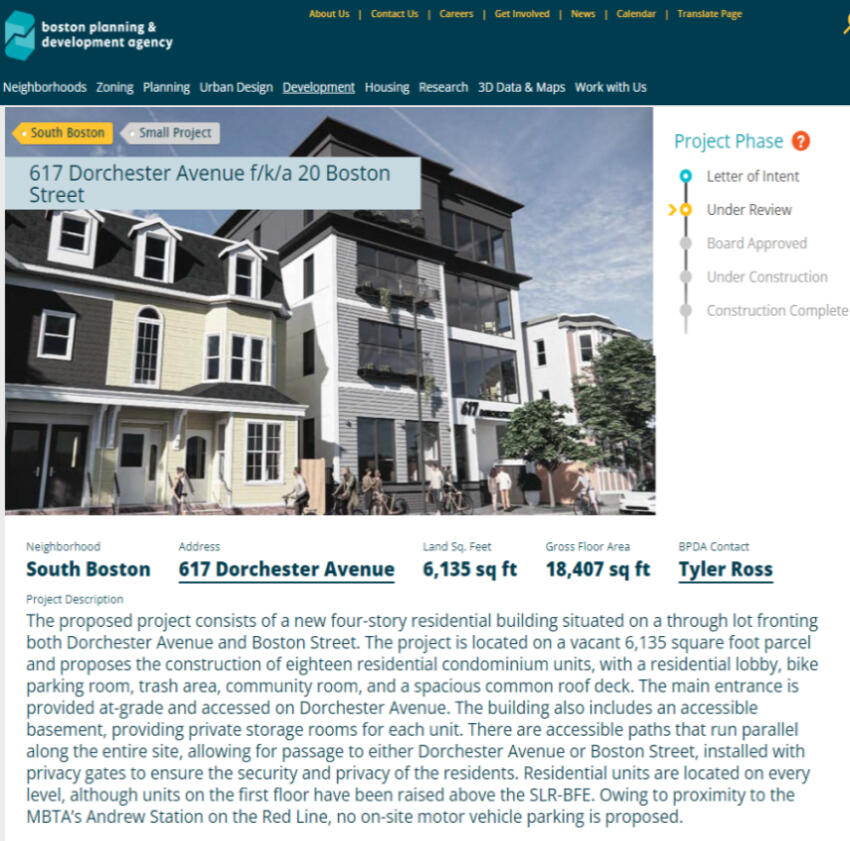
617 Dot. Ave.

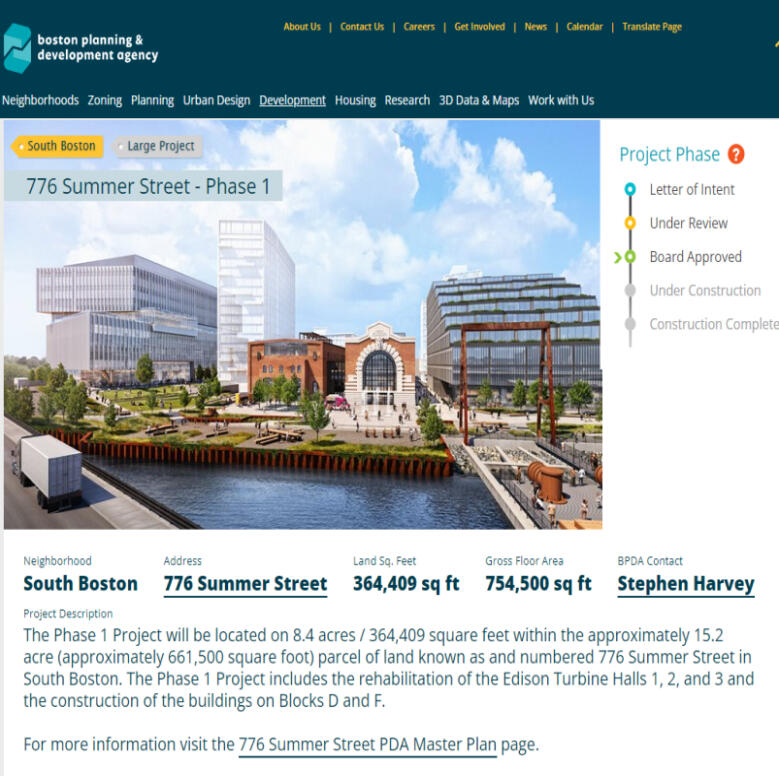
776 Summer St. (Edison) - Demo / Construction phase
Cypher & E Streets Improvement Project starts September 5th.

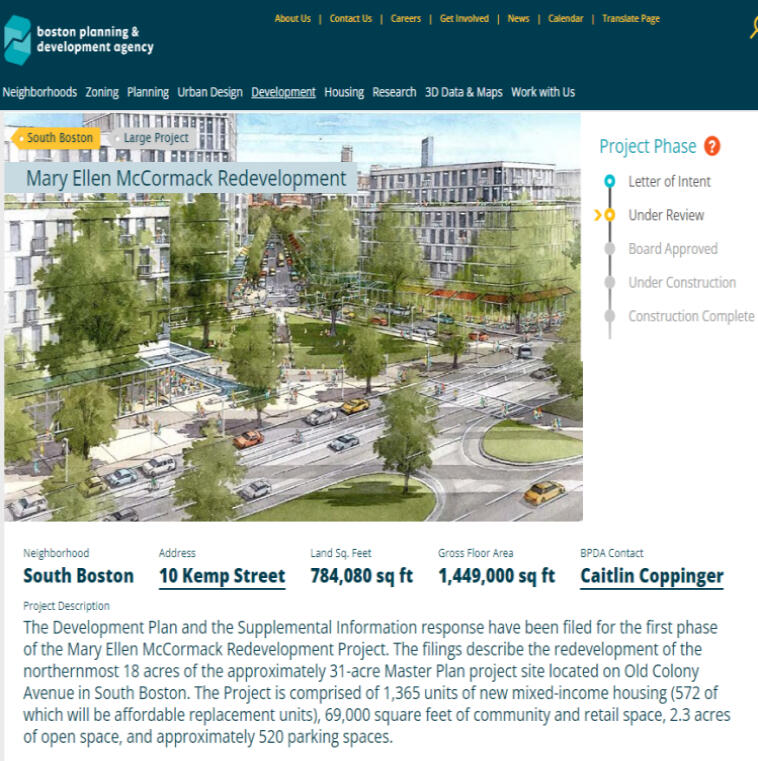
Mary Ellen McCormack - Public Meet 10/11/23 - Comments Open

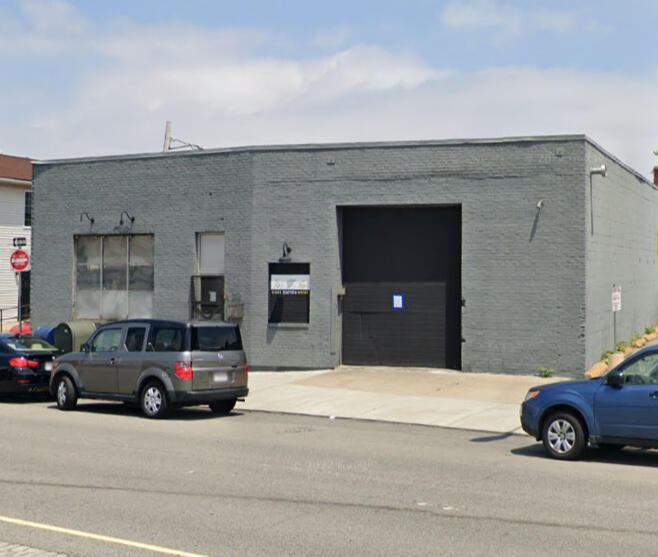
Massport D&E Street

Political Corner
Click on an image for story

Newsletter - Supporting our Veterans and First Responders, Roslindale Parade and More!

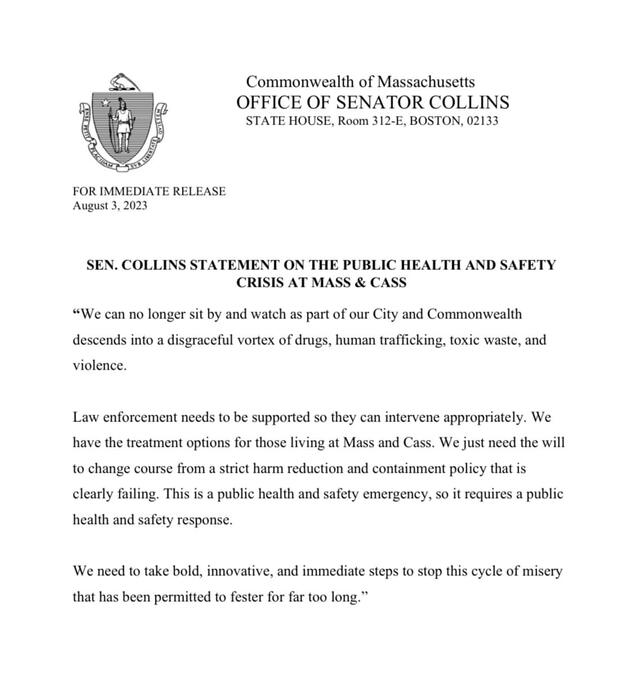
State Senator, First Suffolk District Nick Collins - 2023 Legislative Update

Two of Kickoff For Kids biggest fans / supporters! Senator Nick Collins & Representative David Biele enjoying a beautiful day at the K4K opener @ Evans Field.

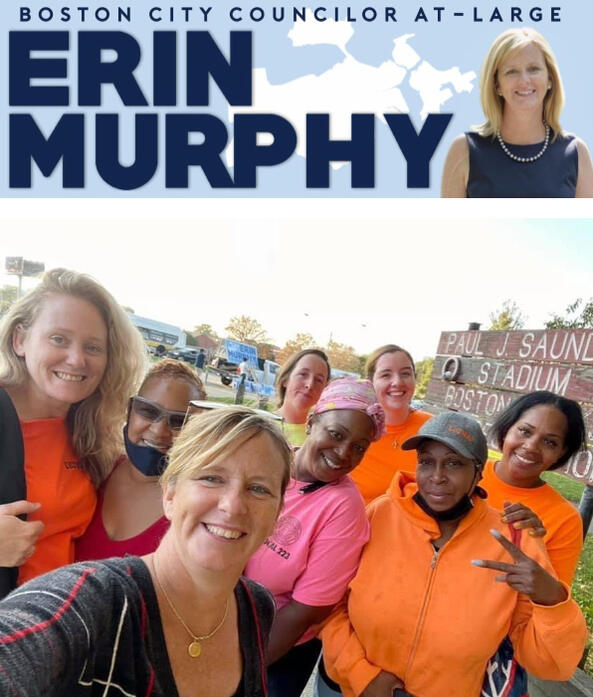
Erin Murphy & Friends @ Joe Moakley Park. Read what people have to say about Erin

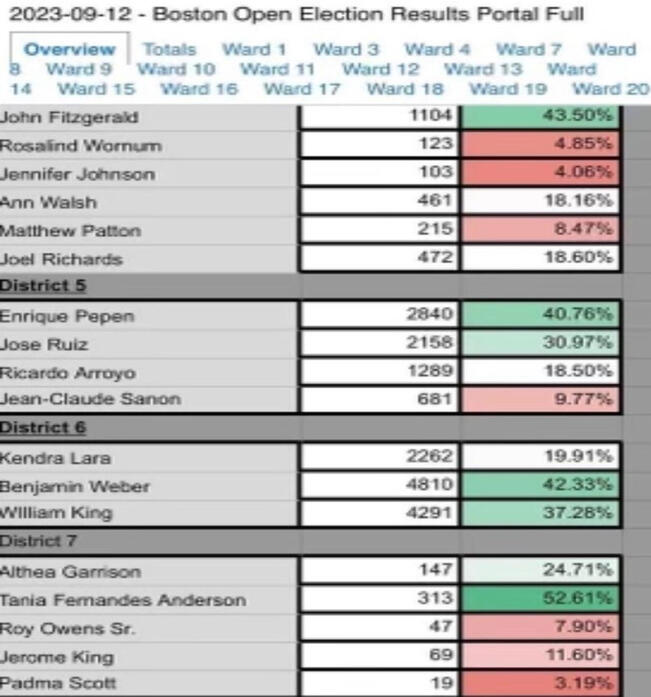
Primary Election 9/12/2023 numbers

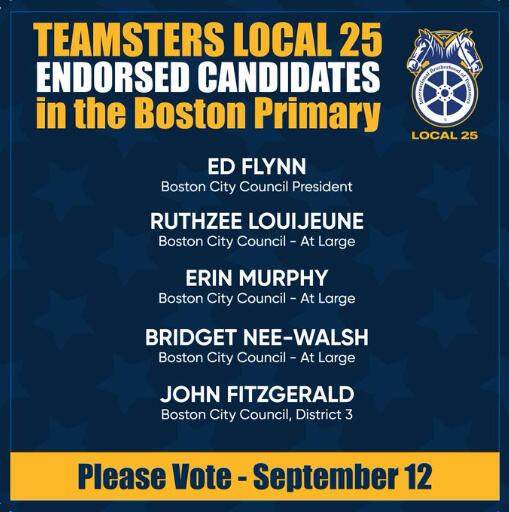
TEAMSTER ENDORSED CANDIDATES IN BOSTON Proud to endorse @EdforBoston @Ruthzee @ErinforBoston @Bridget4Boston_ and John Fitzgerald for Boston City Council on Tuesday!

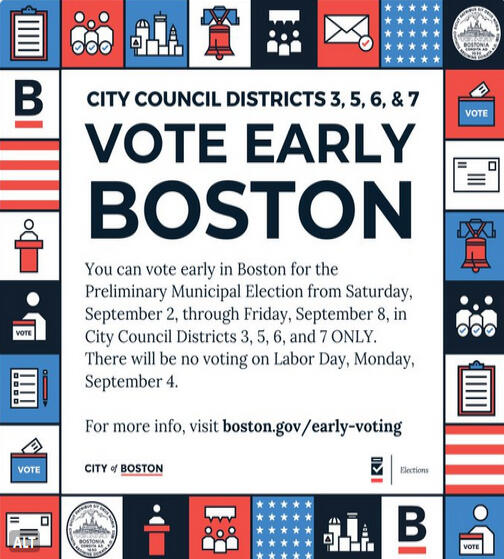
The Preliminary Municipal Election and early voting will ONLY take place in City Council Districts 3, 5, 6, and 7. Early voting will take place Saturday, Sept. 2, through Friday, Sept. 8.

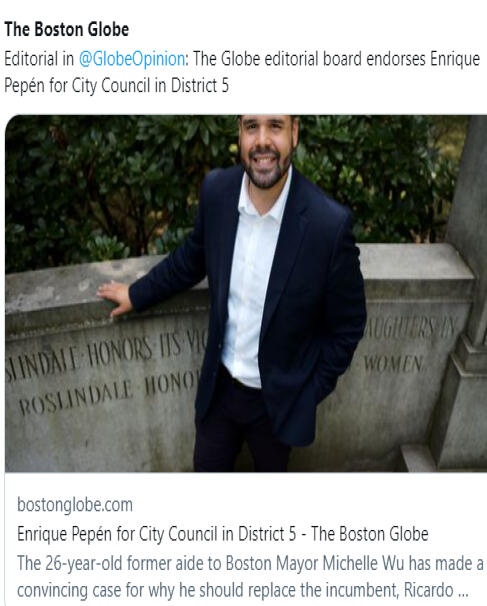
Enrique Pepén for City Council in District 5 The 26-year-old former aide to Boston Mayor Michelle Wu has made a convincing case for why he should replace the incumbent, Ricardo Arroyo.

The City of Boston Primary Election is Tuesday, September 12th. The Preliminary Municipal Election and early voting will ONLY take place in City Council Districts 3, 5, 6, and 7.

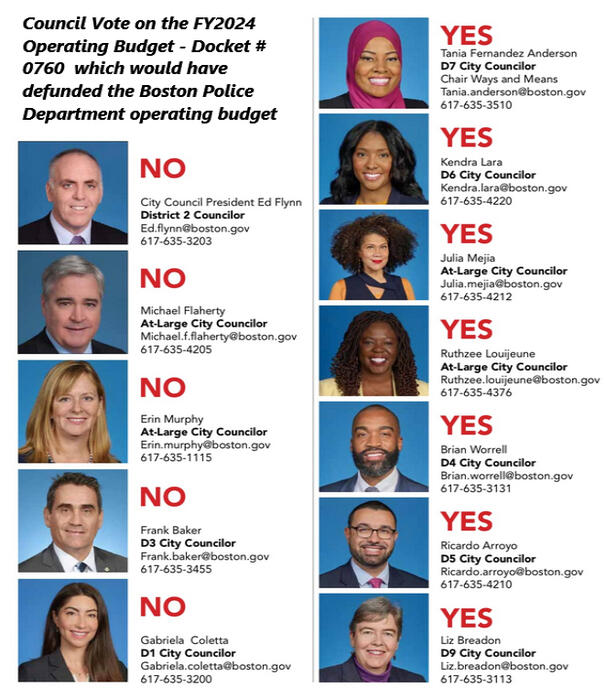
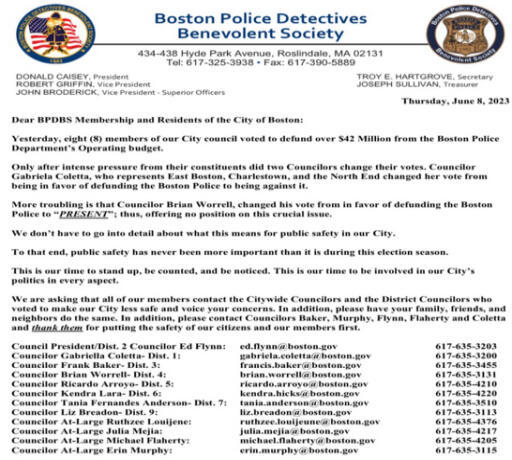
As the incidence of violent crimes escalate, let's look at the City Council vote on the FY2024 Operating Budget - Docket #0760 Who voted to defund the Boston Police Department operating budget.

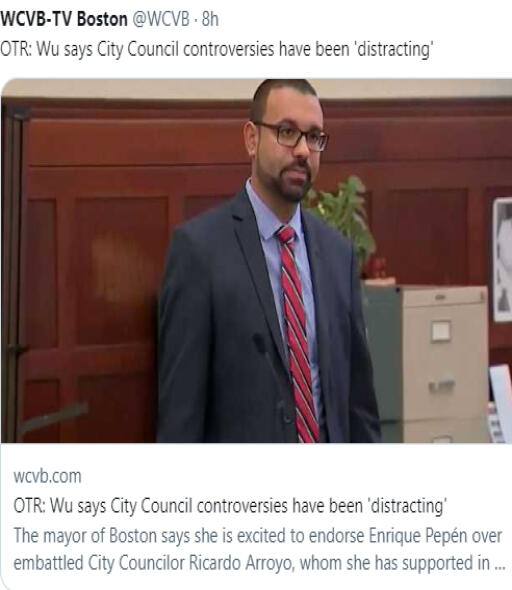
The mayor of Boston says she is excited to endorse Enrique Pepén over embattled City Councilor Ricardo Arroyo, whom she has supported in previous elections.

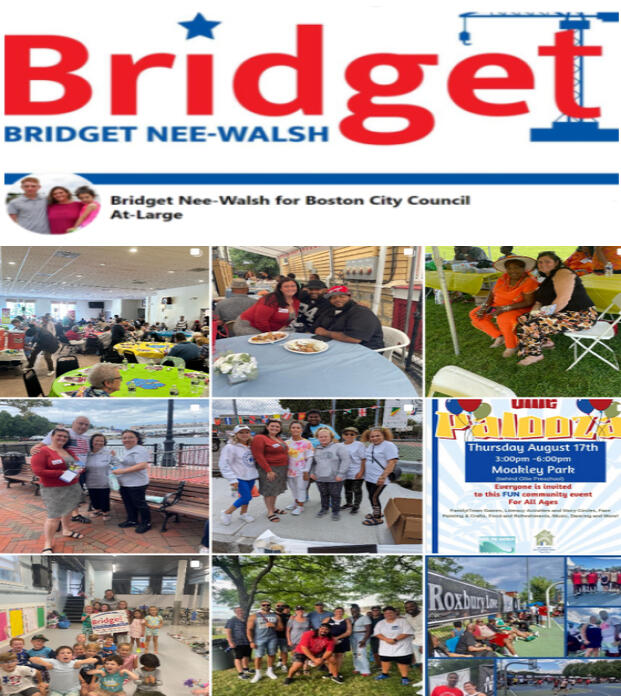
Bridget Nee-Walsh for Boston City Council At-Large

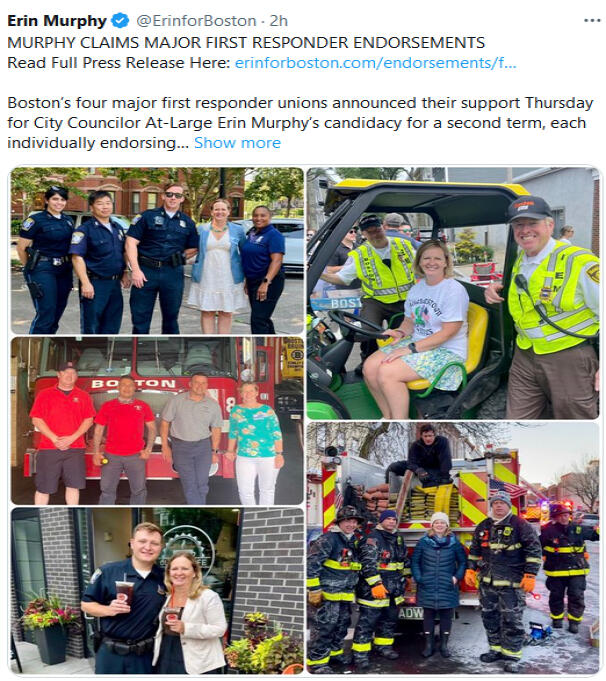
Boston’s four major first responder unions announced their support Thursday for City Councilor At-Large Erin Murphy’s candidacy for a second term.

Vote - Mail-in

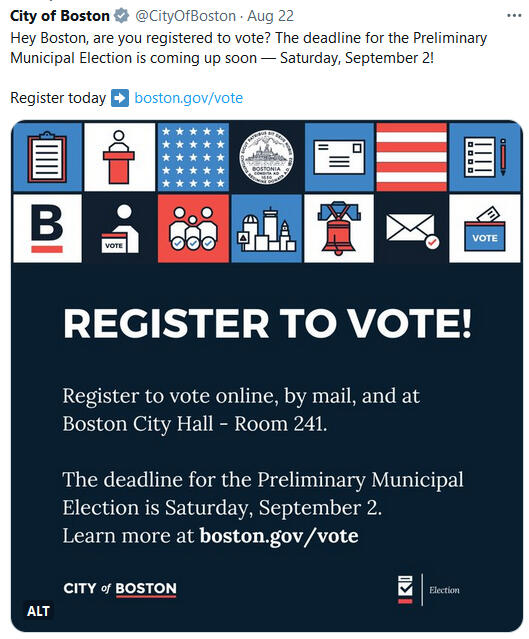
Voter Registration

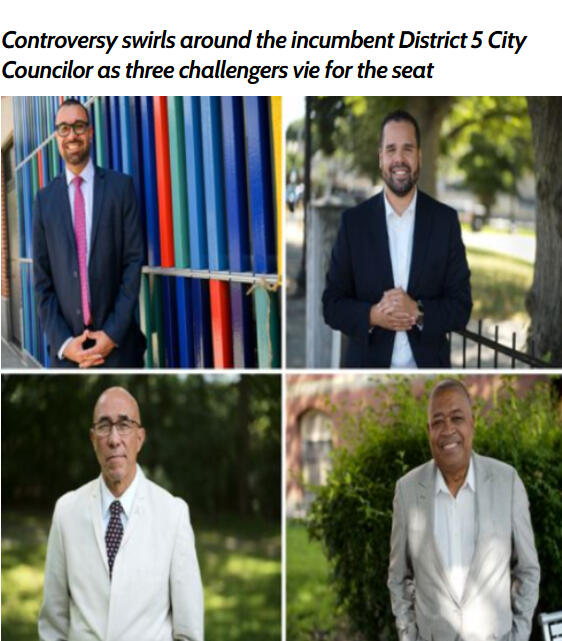
The dynamic in the race for Boston City Council District 5 is simple: Ricardo Arroyo, a progressive incumbent hounded by controversy over the last year, is battling for a third term against three challengers attempting to unseat him.
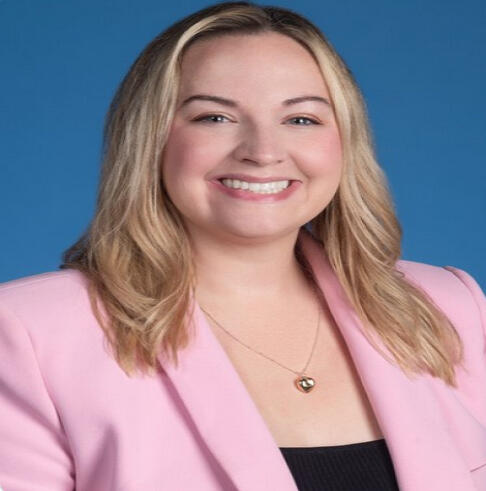
Councilor Sharon Durkan was elected to the Boston City Council for District 8 in the special municipal election on July 25, 2023. She was sworn in on August 7, 2023

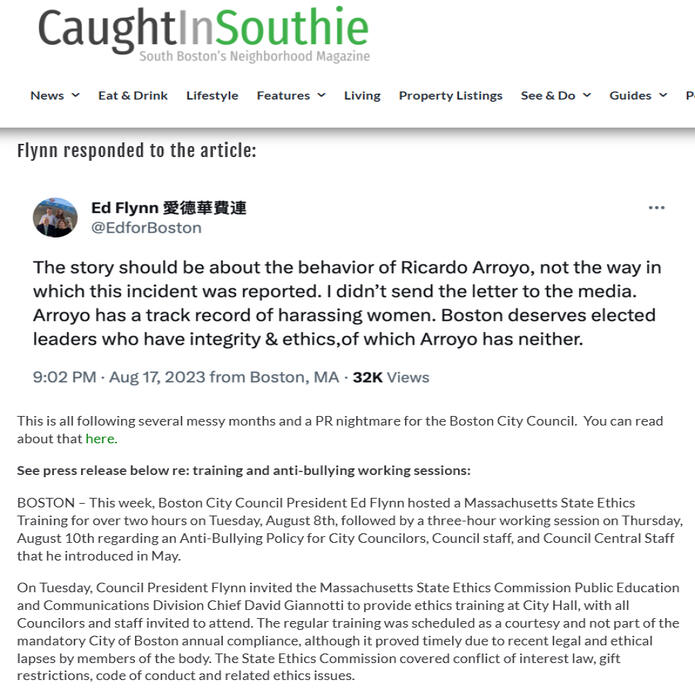
“An Anti-Bullying Policy should have been implemented decades ago, and I intend to do so before my term as Boston City Council President concludes,”said Council President Flynn.

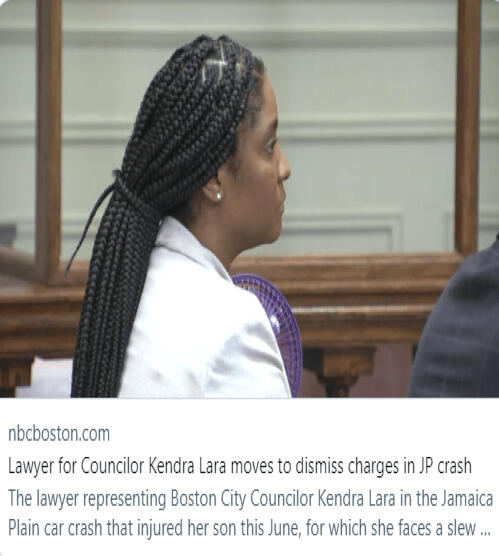
Lawyer for Councilor Kendra Lara moves to dismiss charges in JP crash

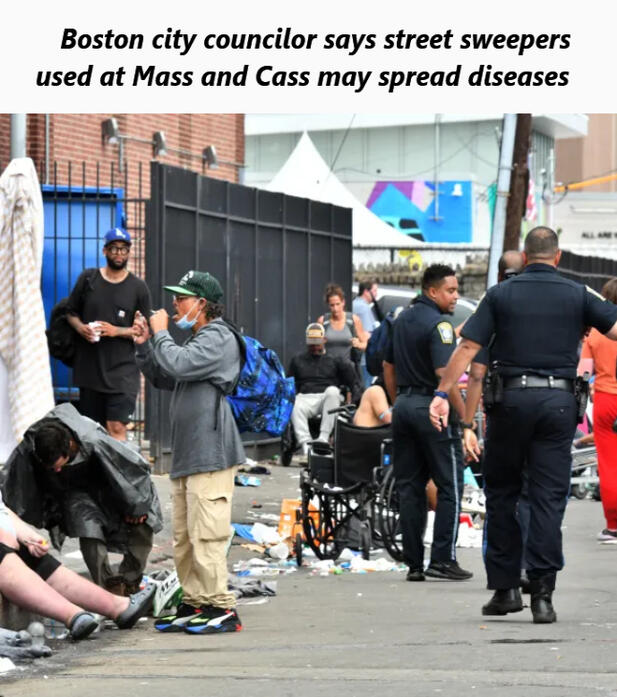
City Councilor Erin Murphy has filed a hearing order to look into whether street cleaning equipment used in the area of Melnea Cass Boulevard and Massachusetts Avenue is spreading infectious diseases to other parts of Boston.

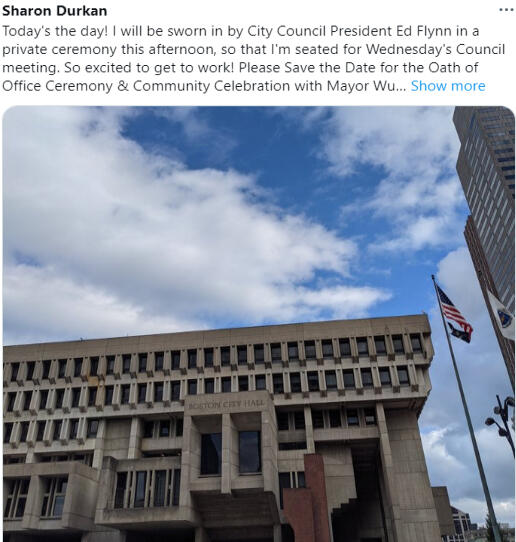
Today's the day! I will be sworn in by City Council President Ed Flynn in a private ceremony this afternoon, so that I'm seated for Wednesday's Council meeting. So excited to get to work! Please Save the Date for the Oath of Office Ceremony & Community Cel

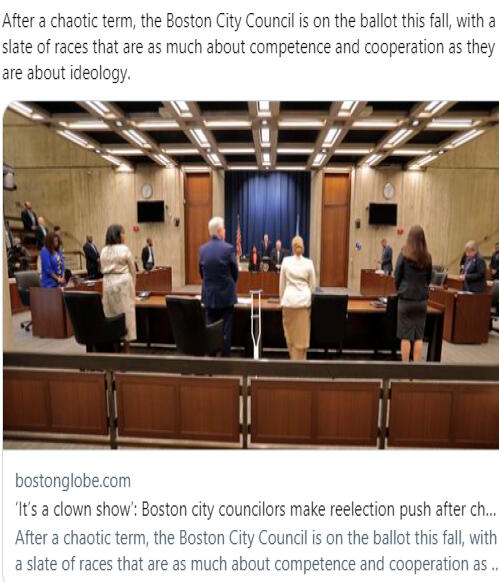
It’s a clown show’: Boston city councilors make reelection push after chaotic term Three embattled progressive councilors face challengers in Sept. 12 contest

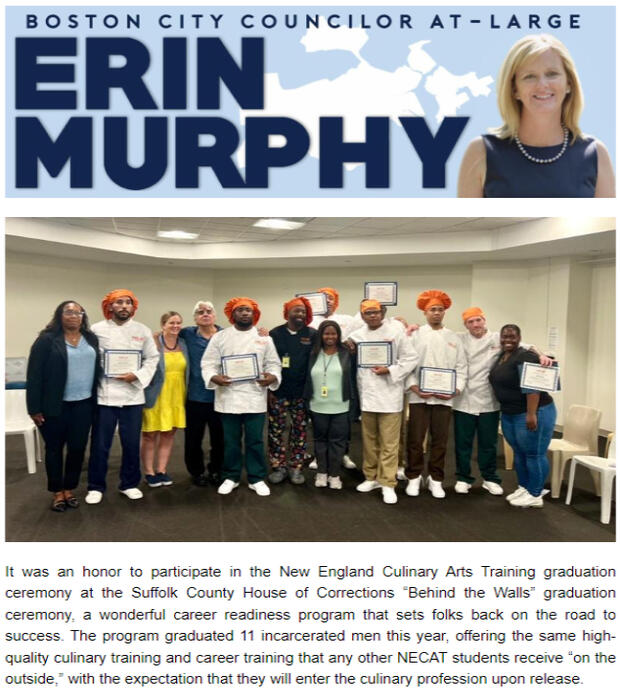
It was an honor to participate in the New England Culinary Arts Training graduation ceremony at the Suffolk County House of Corrections “Behind the Walls” graduation ceremony

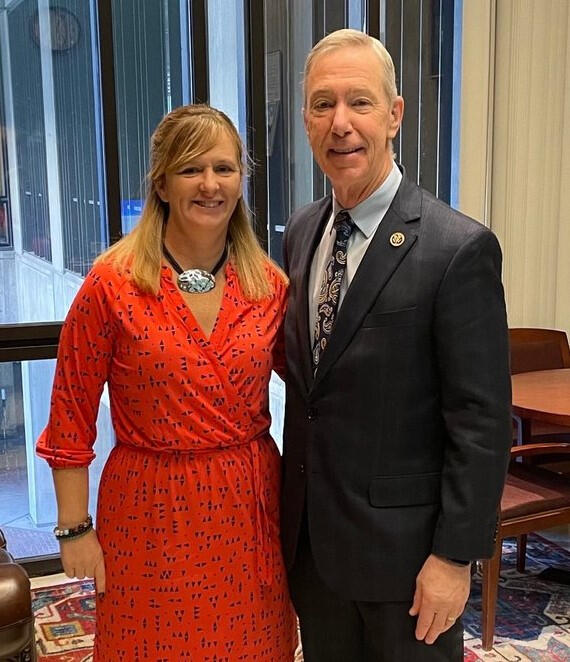
CONGRESSMAN STEPHEN LYNCH ENDORSES ERIN MURPHY FOR BOSTON CITY COUNCIL AT-LARGE

.
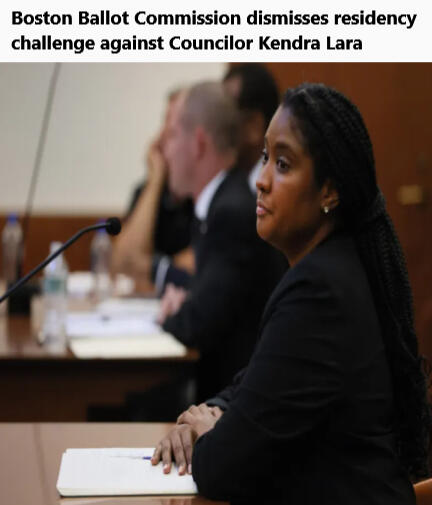
The unanimous ruling from the four commissioners allows Lara to move forward with her candidacy for District 6 councilor.

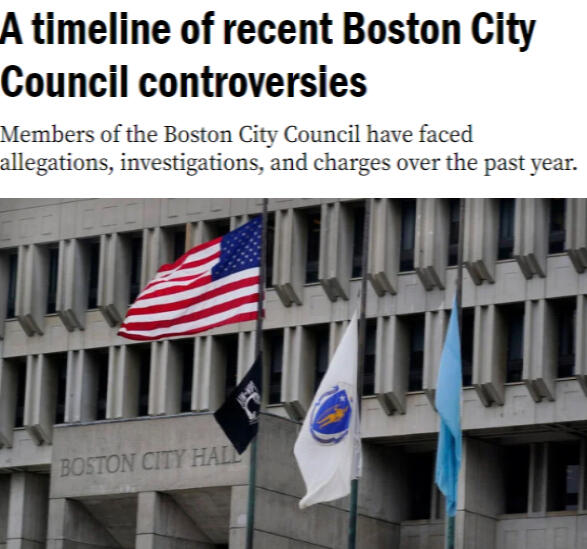
Boston City Council have dealt with a variety of controversies.
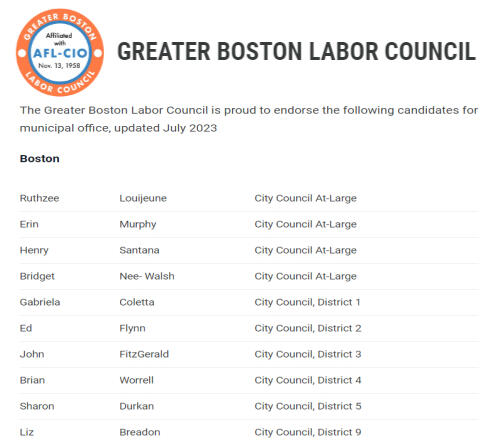
The Greater Boston Labor Council is proud to endorse the following candidates for municipal office, updated July 2023
There was a time not too long ago when politicians embroiled in scandals put constituents before career and resigned from their posts.

Boston City Councilor Tania Fernandes Anderson admits to ethics violations - Fined $5,000
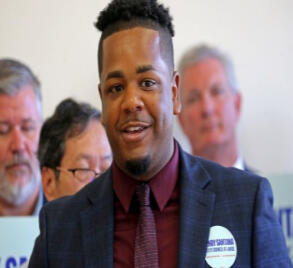
Mayor backs candidate for Boston City Council though he’s never once voted

A look at 8 running for 4 at-large seats
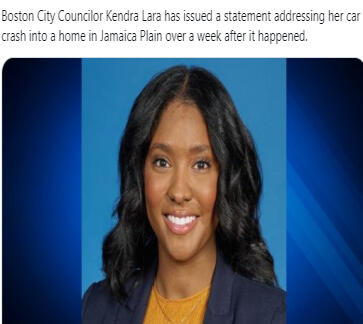
Councilor Lara Issues Statement

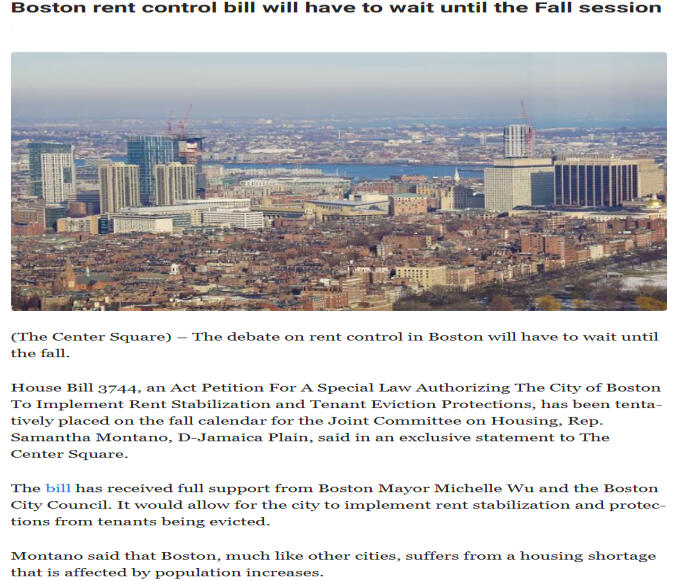
Rent Control Bill In Boston
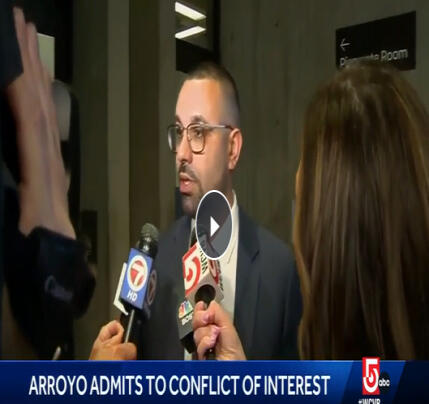
Arroyo to pay $3,000 State Ethics Comm. fine.
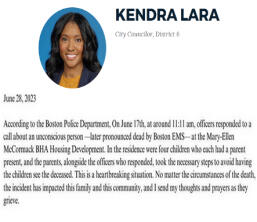
Councilor Lara to three other Councilors on that South Boston apartment: Shame

Police & Veterans cuts were not my fault says City Councilor in charge of budget
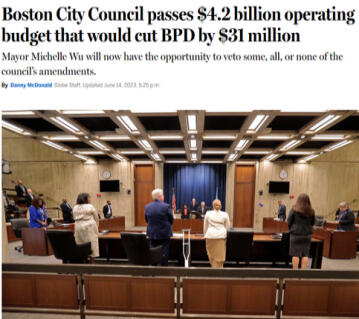
City Council passes $4.2 billion operating budget that would cut BPD by $31 million

BPDBS Seeks Support In Opposition To Proposed FY2024 Budget Cuts
Unions & former District 3 Councilor throw support to Fitzgerald

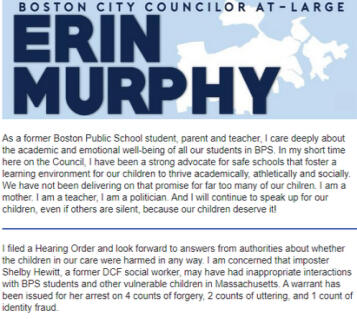
Councilor Murphy files a hearing order to get answers rerarding a former DCF social worker - Shelby Hewitt interactions at BPS
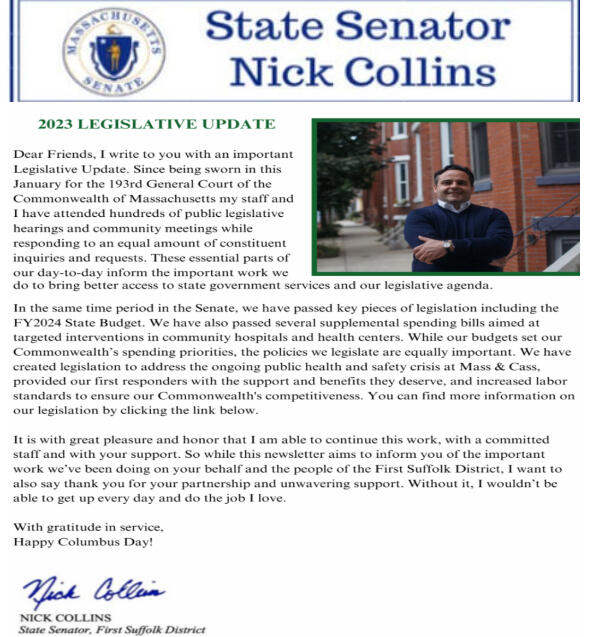



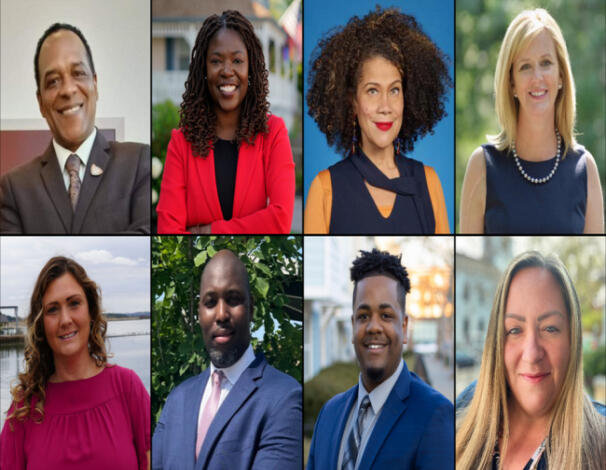


Update from State Senator Nick Collins
Mass. State Representative David Biele


Update from Mayor Michelle Wu

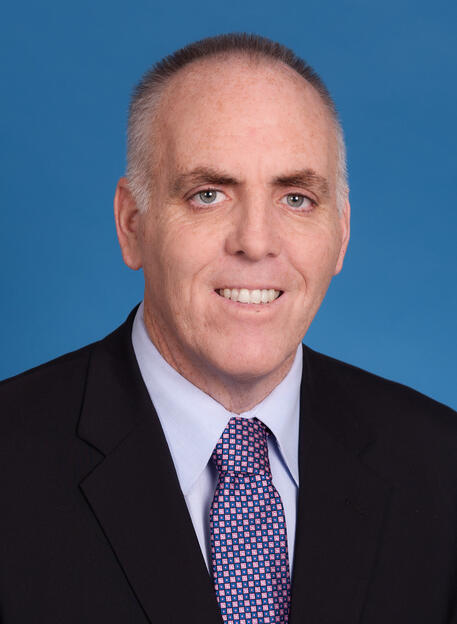
City Council President Ed Flynn

City Councilor Michael Flaherty


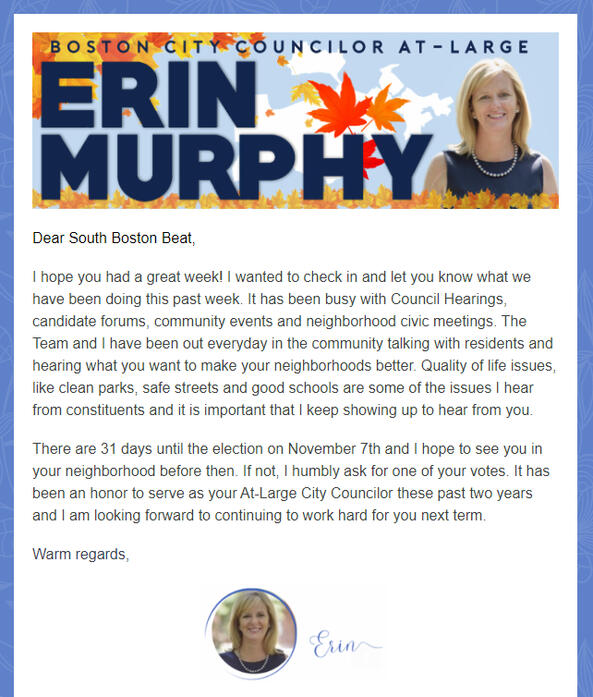
City Councilor, At-Large Erin Murphy

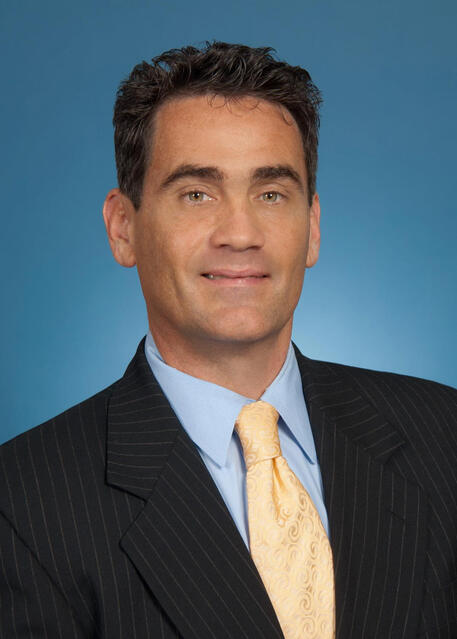
City Councilor Frank Baker


City Councilor, At-Large Ruthzee Louijeune


City Councilor, At-Large Julia Mejia


Mayor's 'ONS' - So. Boston Liaison - Anna White
Public Safety
Click on an image for story

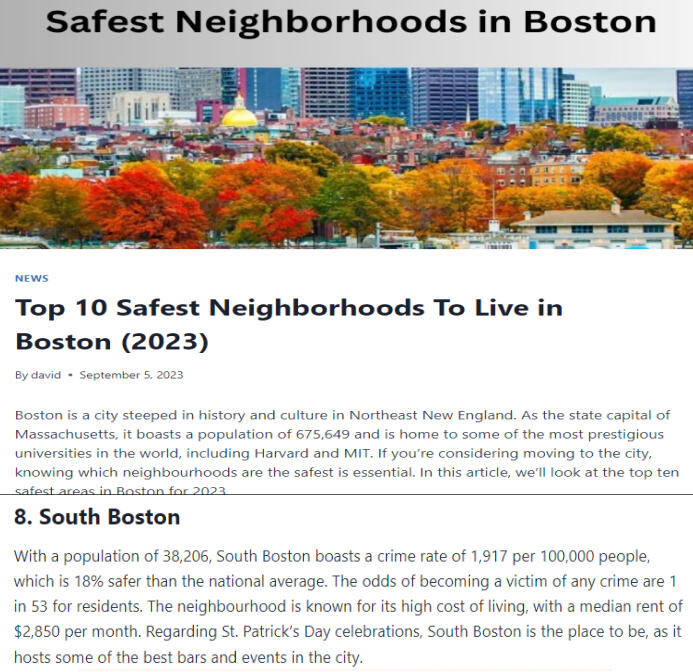
Top 10 Safest Neighborhoods To Live in Boston (2023)

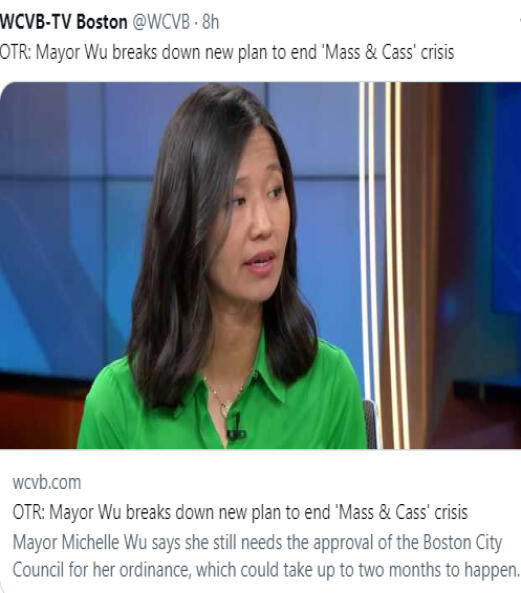
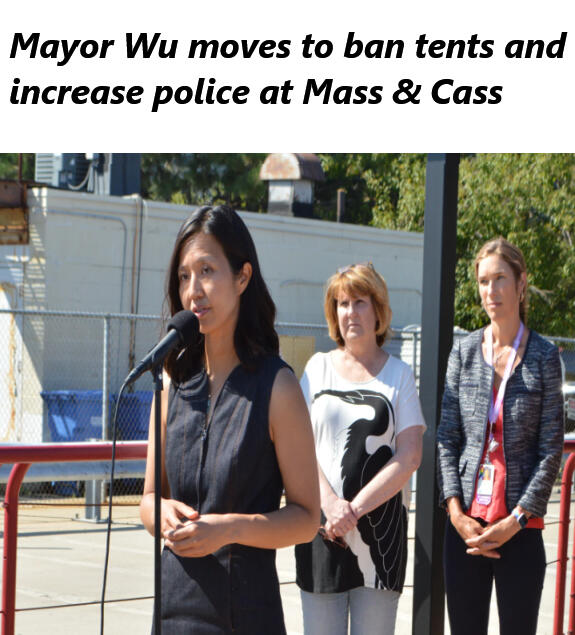
Mayor Wu breaks down new plan to end 'Mass & Cass' crisis in Boston

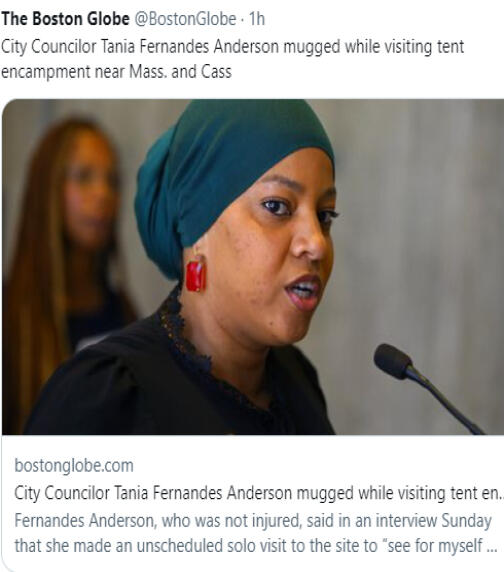
Boston City Councilor Tania Fernandes Anderson was mugged as she stopped near Atkinson Street Saturday night to observe the conditions at a tent encampment in the area known as Mass. and Cass

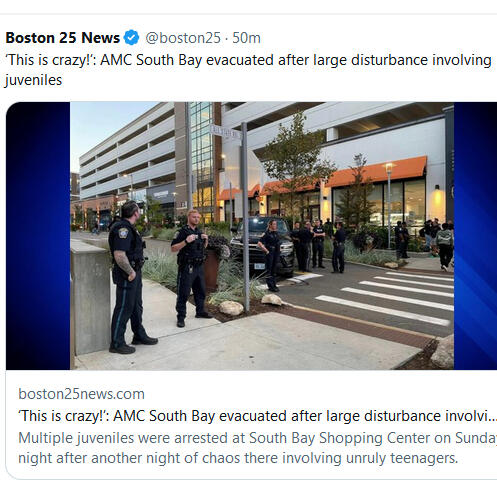
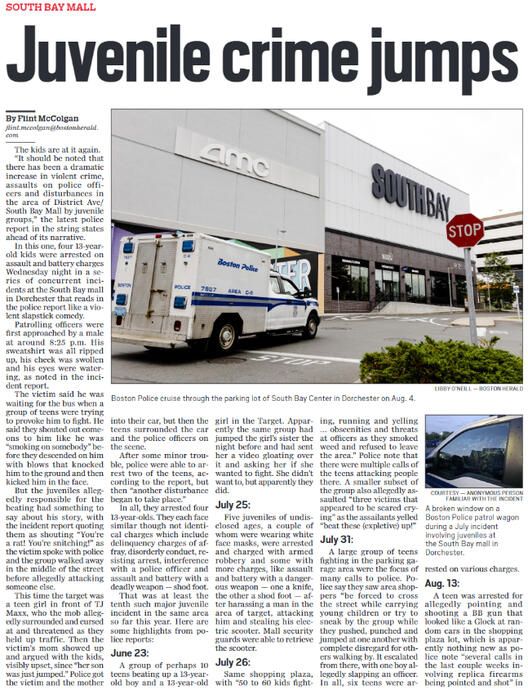
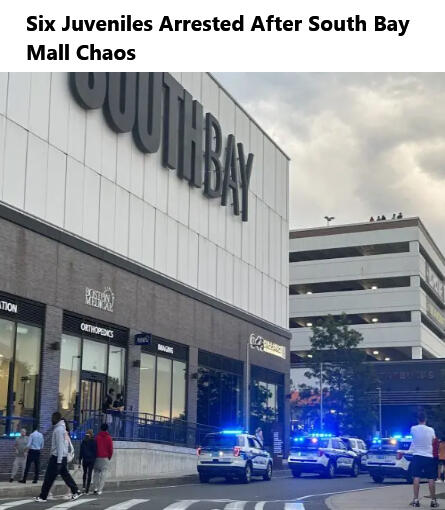
‘This is crazy!’: AMC South Bay evacuated after large disturbance involving juveniles
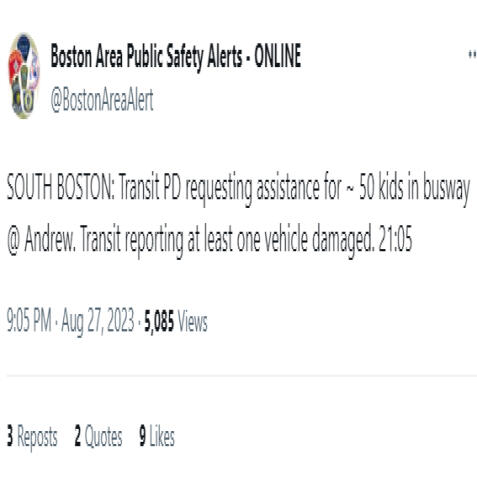
.

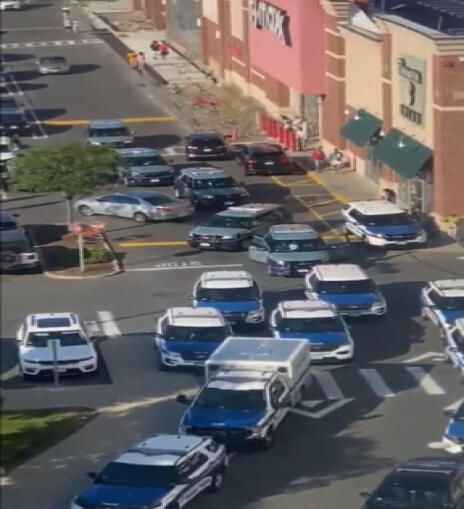
Boston Police from across the city as well as outside agencies once again responding to South Bay for large groups of youth fighting and attacking officers. Several have once again been arrested. 8/27/2023

Boston Mayor Michelle Wu plans to issue an ordinance by the end of the month that will ban encampments of unhoused people at Mass. & Cass

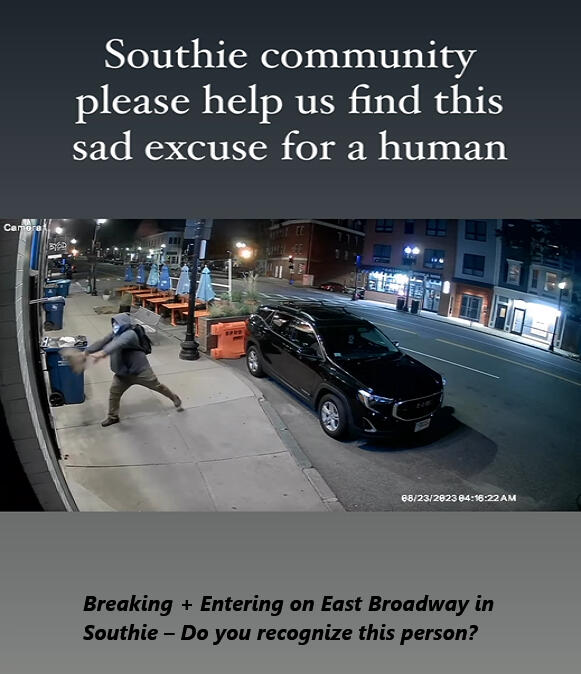
Breaking + Entering on East Broadway in Southie – Do you recognize this person?

South Bay Mall Public Safety Concerns (Boston Herald)

According to Boston police, on Wednesday, August 16, officers were on patrol in the area of District Avenue in the South Bay Mall area, when they were approached by a victim who was just attacked by a group of juveniles.

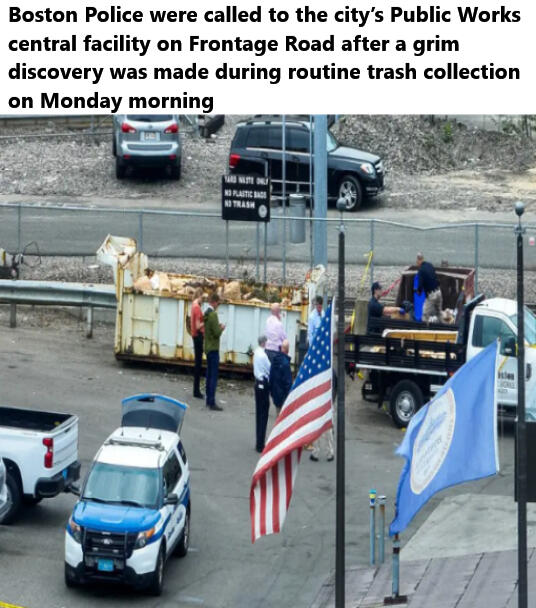
Boston Police were called to the city’s Public Works central facility on Frontage Road after a grim discovery was made during routine trash collection on Monday morning

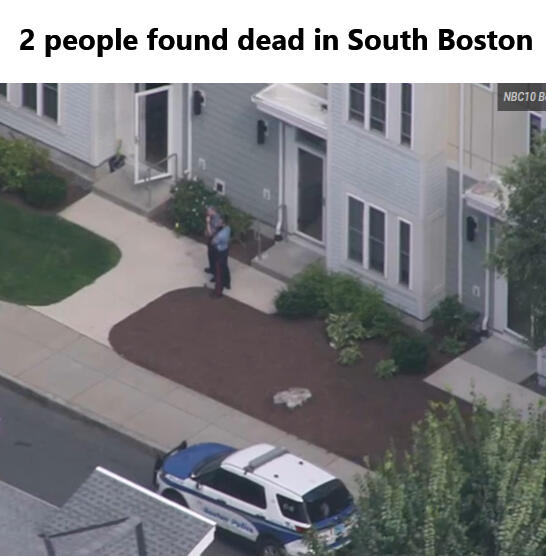
Two people were found dead in South Boston Wednesday afternoon, police said, but it wasn't immediately clear if the deaths were believed to be suspicious. The bodies on Patterson Way near Rev Burke Street were reported about 1:30 p.m., Boston police said.

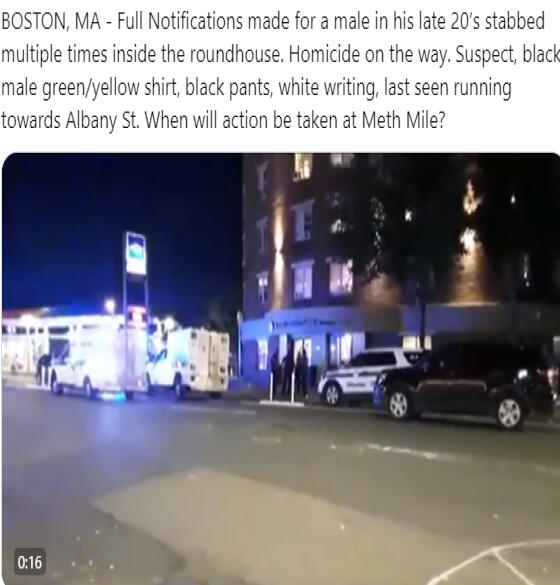
Male in his late 20’s stabbed multiple times inside the roundhouse. Homicide on the way.

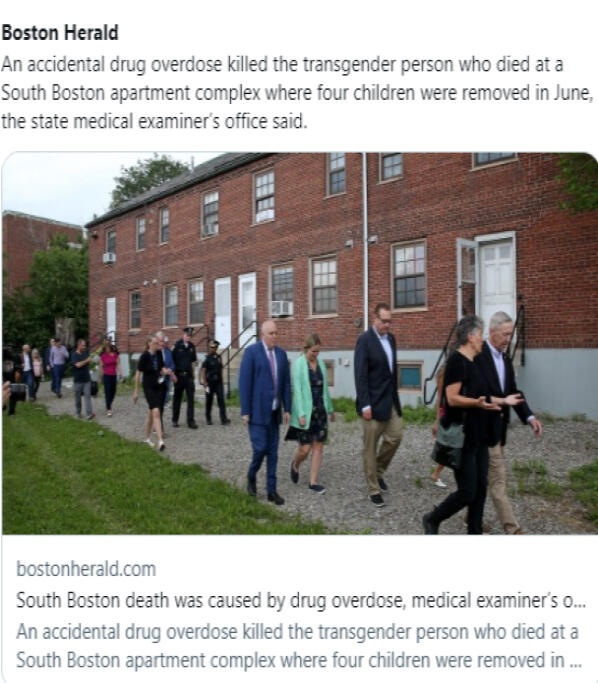
An accidental drug overdose killed the transgender person who died at a South Boston apartment complex where four children were removed in June, the state medical examiner’s office said. The cause of death was determined to be “acute intoxication due to t

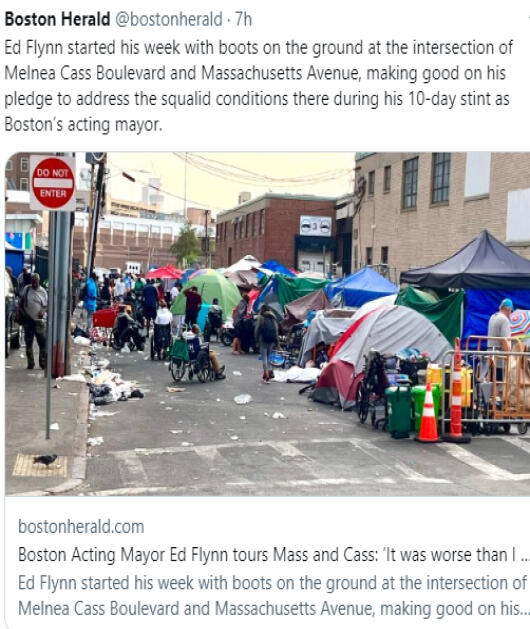
Boston Acting Mayor Ed Flynn tours Mass and Cass: ‘It was worse than I expected’

Details about the death investigation underway at 400 Frontage Road, the Boston Public Works' Central Maintenance Facility, weren't immediately available beyond that police were called about 10:10 a.m., according to the Boston Police Department.

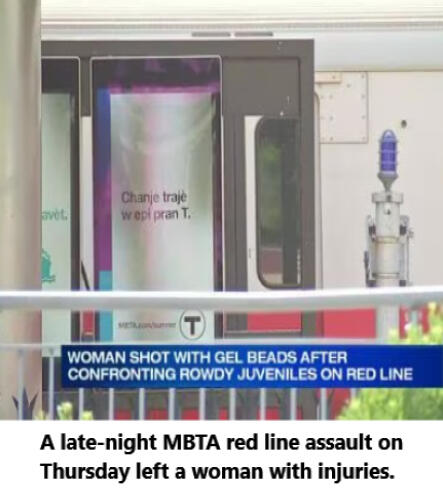
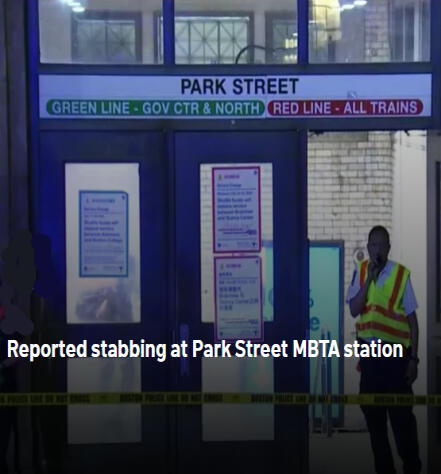
A late-night MBTA red line assault on Thursday left a Dorchester woman with injuries

Boston Police Officers Arrest 17-year-old Juvenile and Recover Loaded Firearm in the area of Flaherty Way in South Boston.

Loved ones of Jazreanna Sheppard, South Boston woman stabbed near Common, seek justice and support from the community

Lawmakers demand warrant sweep in Mass and Cass encampment

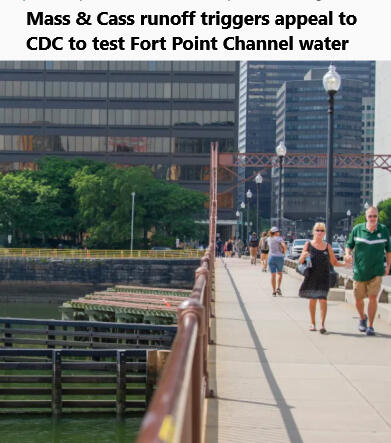
“We have recently learned that catch basins in the area known as Mass & Cass dump right out into Boston Harbor via the Fort Point Channel without any filtration,”

Six teenage boys were arrested in South Boston around 7 p.m. on Monday, July 31, after they assaulted several police officers, according to the Boston Police Department .
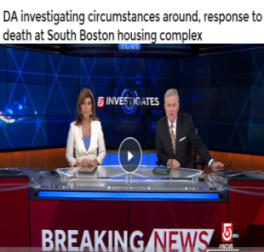
District Attorney's Office is investigating the death of a man inside a South Boston housing complex

Brutal Stabbing Near Southampton Street Shelter Raises More Concerns and Urges City Action

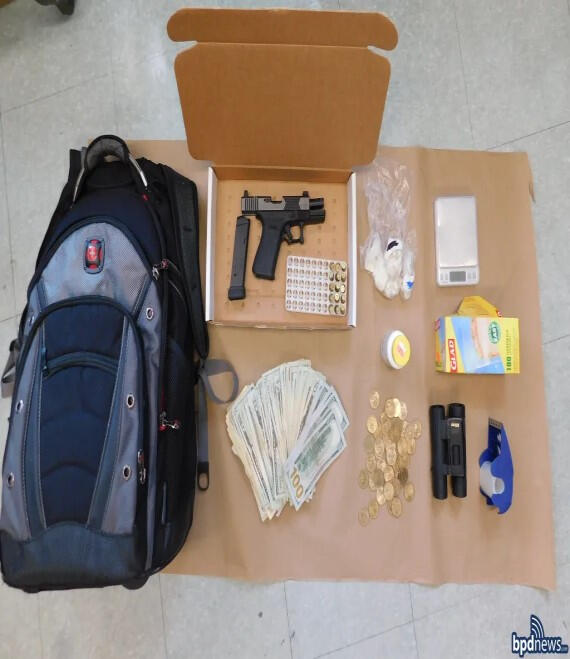
Officers Arrest Suspect On Firearm And Drug Trafficking Charges In The Area Of Southampton Street
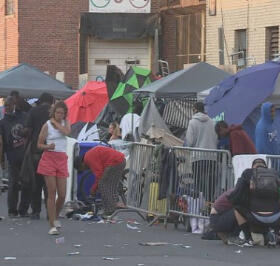
‘Ticking time bomb’: BFD union president calls for immediate action at Mass & Cass
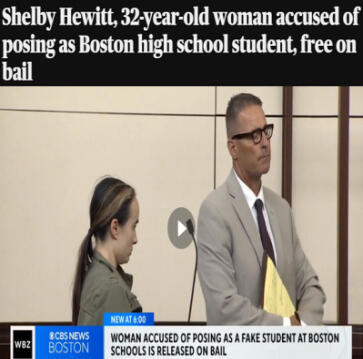
Shelby Hewitt back in court.

Mosquito pool in South Boston tested positive for West Nile Virus
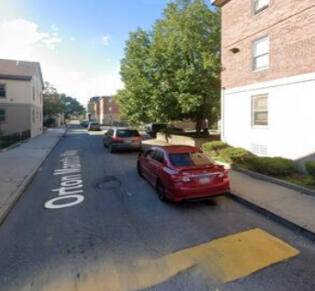
Nighttime Shooting Incident Reported at Orton Marotta Way, So. Boston
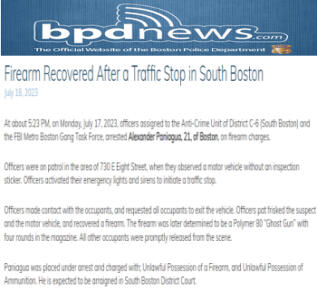
Gun Recovered 7/17/2023

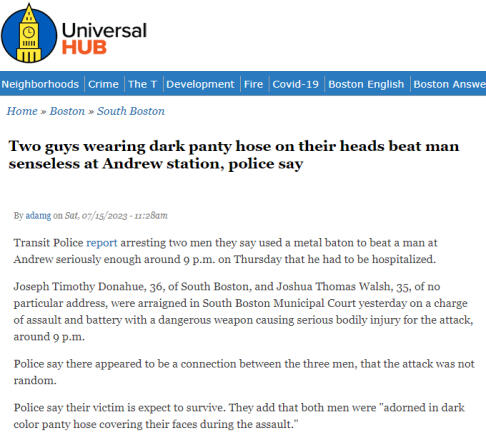
MBTA Andrew Station: Man beaten

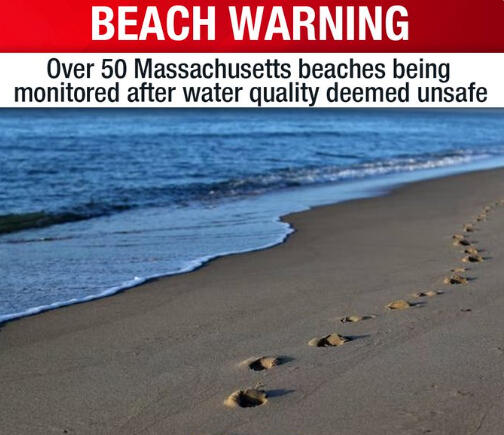
Beach Warnings
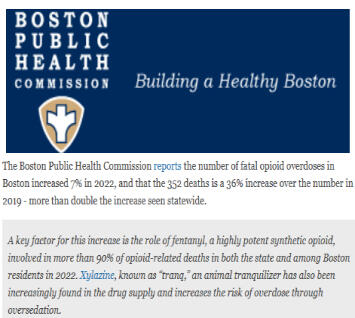
Fatal overdoses increasing in Boston

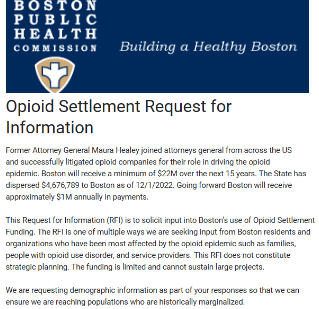
BPHC RFI
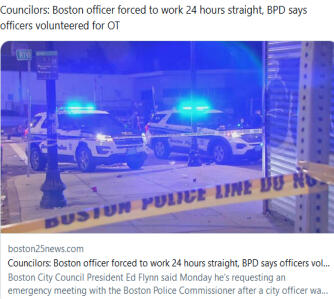
Boston Police spokeswoman said, “No officers were ordered to work 24 hours.”
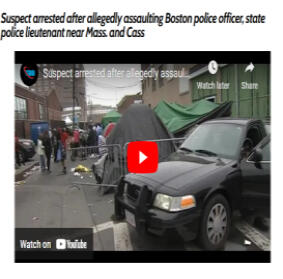
Suspect arrested after allegedly assaulting Boston police officer, state police lieutenant near Mass. and Cass

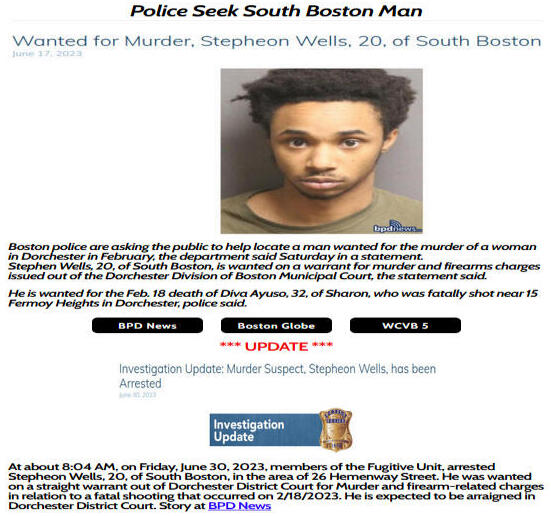
Police Seek South Boston Man - Murder Charges

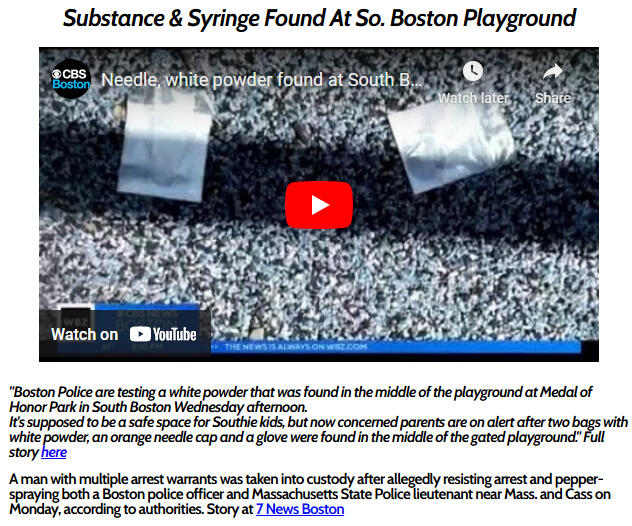
Substance & Syringe Found At So. Boston Playground

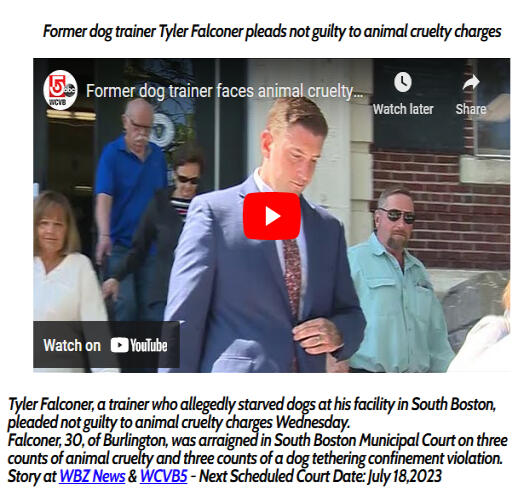
Former dog trainer Tyler Falconer pleads not guilty to animal cruelty charges

.




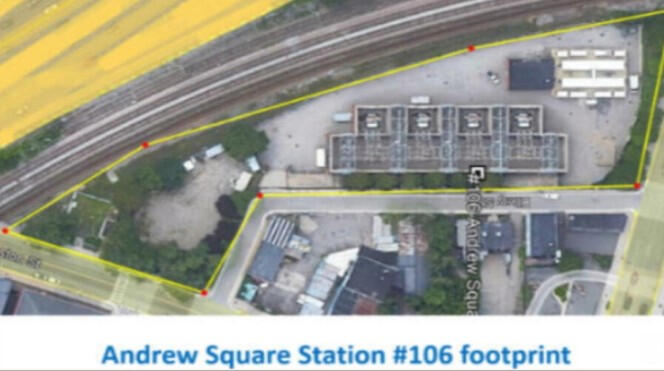
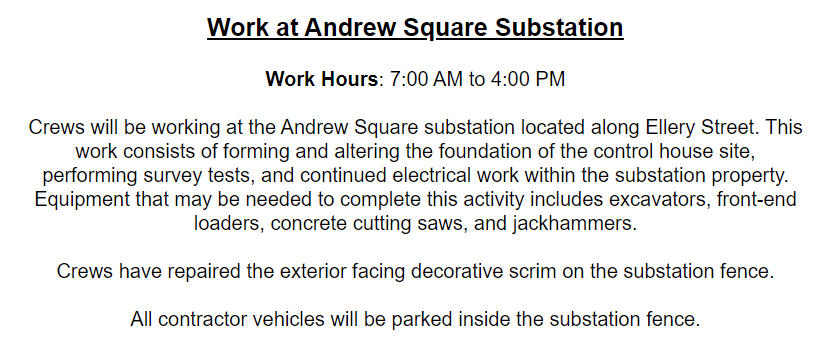
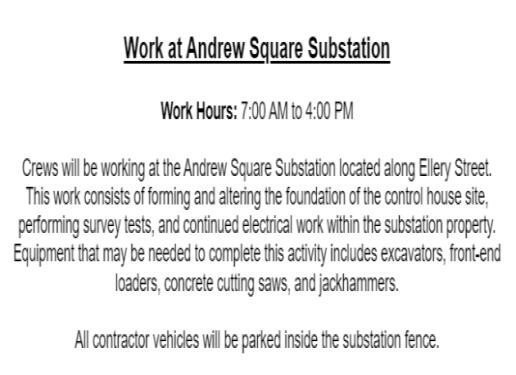
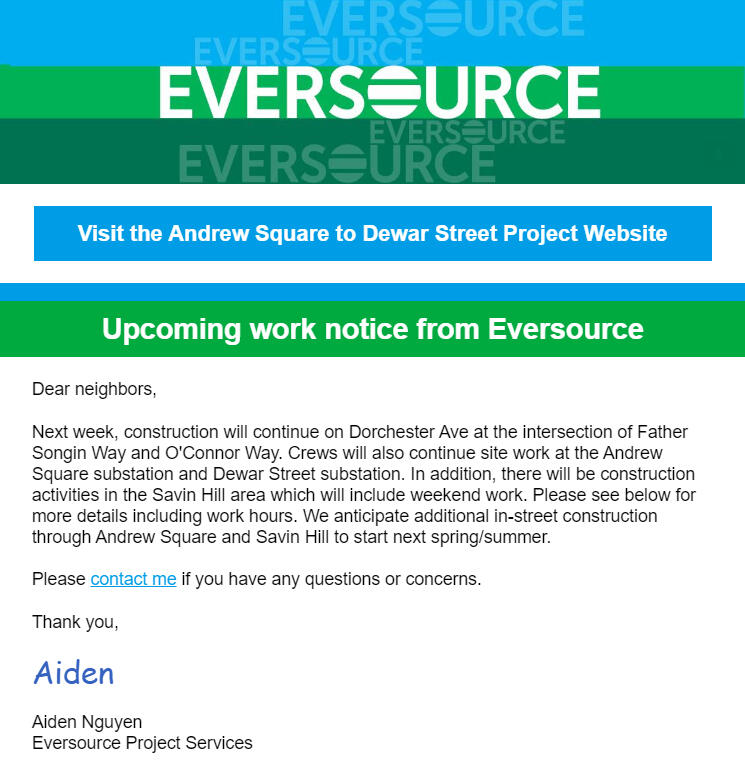
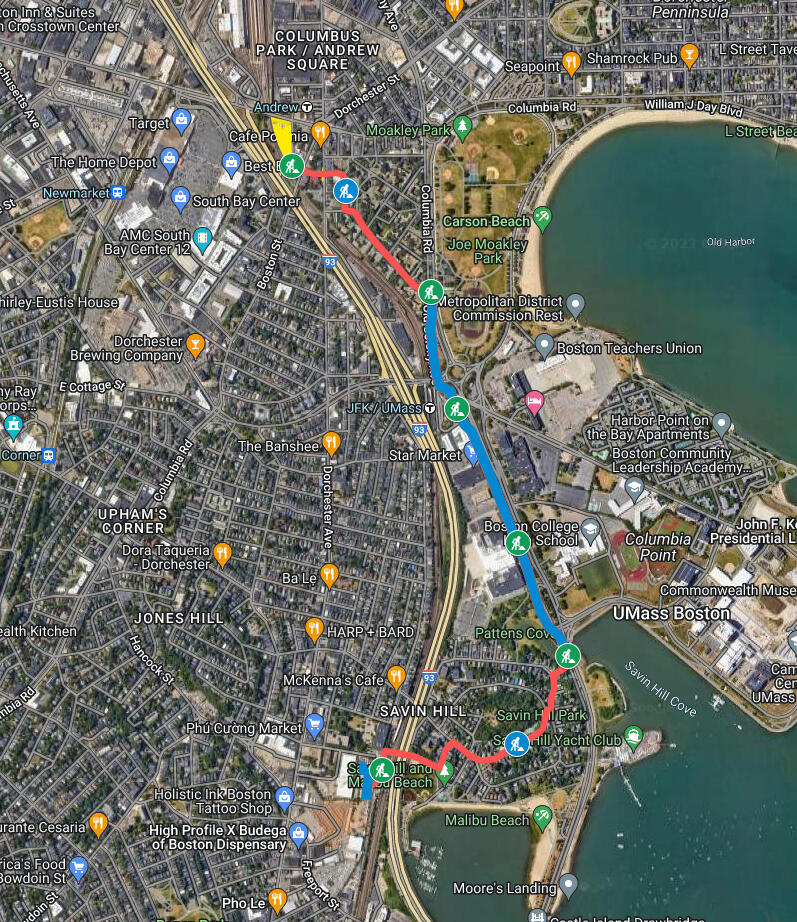
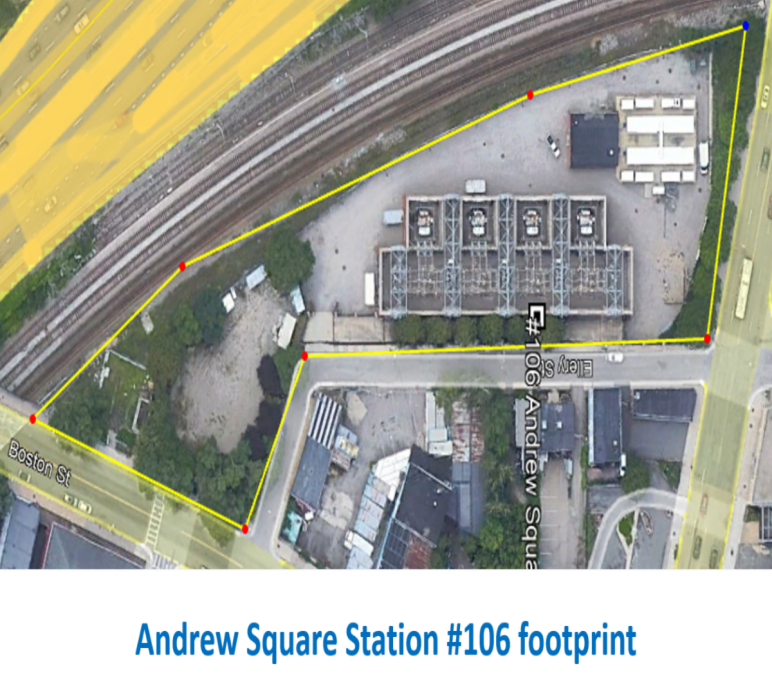
Security Cameras To Be Installed At Eversource Substation Location
Coucilors Frank Baker - Ed Flynn - Michael Flaherty filed Docket #1106 and supported the motion to unanimous approval of the Council Vote.
"Docket 1106 Message and order authorizing the City of Boston to accept and expend the amount of Nineteen Thousand Six Hundred Ninety-One Dollars and Eighty Cents ($19,691.80) in the form of a grant for the Eversource Agreement, awarded by the Donor Group to be administered by the Police Department. The grant will fund the purchase and installation of security cameras in the vicinity of the Andrew Square Substation"
Link to Council Meeting recorded minutes as it applies to the aforementioned docket: https://drive.google.com/file/d/1wSnNiOpFT9ReRDOXjPU1Fs1T9LMFaBHH/view?usp=sharing
Mayors filing here
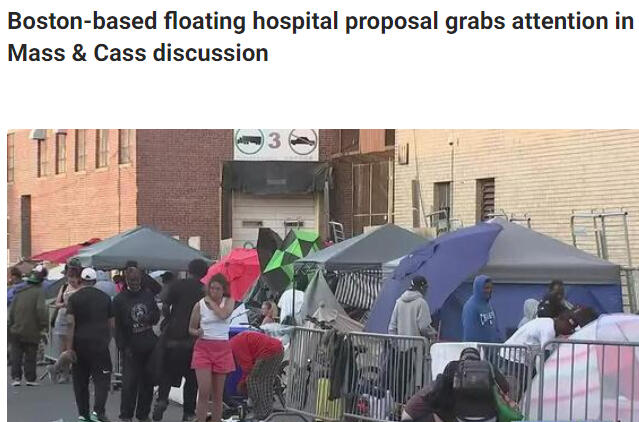
A proposal to explore converting a decommissioned cruise ship into a floating recovery treatment hospital is grabbing attention in the continuing conversation around Mass and Cass.The idea was discussed during Tuesday night’s monthly meeting of the South End-Newmarket-Roxbury Working Group on Addiction, Recovery, and Homelessness.State Senator Nick Collins made the proposal that has already been approved by fellow senators as an amendment to their fiscal 2024 budget.The Boston Democrat discussed how he believes it could help the crisis on the Mass and Cass corridor.
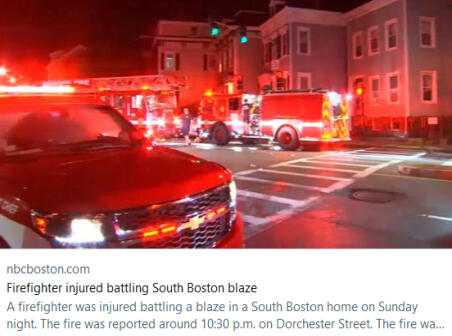
"Fire officials said one person lived in the home, and they were able to escape safely. A firefighter was taken to a local hospital with a hand injury. Story here"


About Us
South Boston Beat exists to bring awareness and shed light on areas of development, and events in the community. We believe that the community voice needs to be heard in all aspects of city planning. It is our hope that with the dissemination of information, informed residents will become involved.We encourage neighborhood improvement and embrace well planned development; the likes of which contribute positively to the vitality, and betterment of the community. Development that preserves the historic character of our neighborhood, protects our remaining open space, and enhances the viability of our residential and commercial corridors is paramount.Our hopes are for long-term quality residency, whether it be in the residential or commercial sectors. That our community be vibrant, resilient, and sustainable, having great places to live, work, and play.
Petitions & Surveys
Sign the petition to support affordable housing on D Street
South Boston NDC demands the inclusion of affordable housing in the Request for Proposals (RFP) currently being considered by the Massachusetts Convention Center Authority. We believe that affordable housing is a fundamental right and a crucial element for the well-being and sustainable development of our community.Three parcels totaling 6 acres of unoccupied land along D and E streets across from the Boston Convention and Exhibition Center are available for development. Two community meetings have already been held on the RFP process to get community input, with one more to come on June 8 at 6 p.m. at 105 W. First St.The planned RFP calls for developing the area to provide a mid-price market to support the hotels and businesses open in the area. There is no mention of affordable housing. But SouthBoston residents have suggested adding affordable housing and open space to the RFP.As South Boston continues to experience rapid growth and development, the rising cost of housing has reached alarming levels, making it increasingly difficult for low- and mid-incomefamilies and individuals to secure affordable homes.We recognize the RFP presents a unique opportunity to address the pressing need for affordable housing and open space in our area. Please sign our petition requesting that MCCA incorporate affordable housing and open space in the final RFP. THANK YOU!
Please consider taking MBTA Customer Survey - MBTA wants riders feedback.
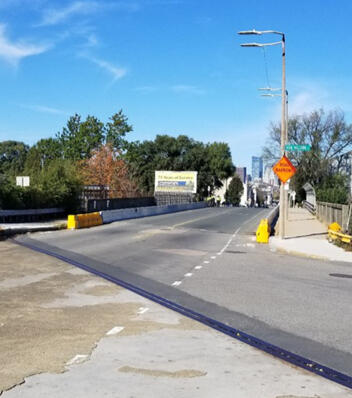
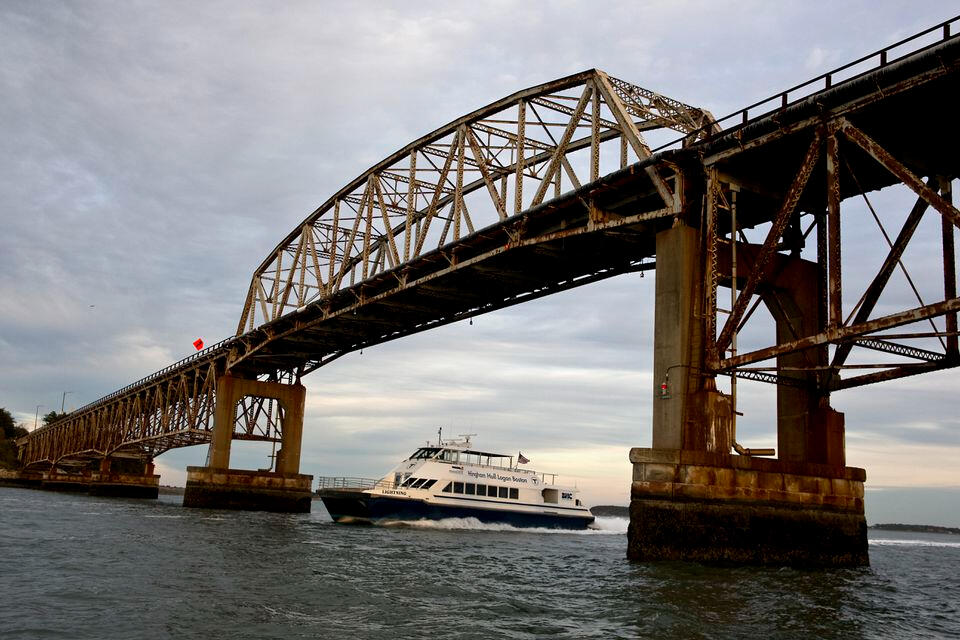
Help Support The Effort To Rebuild The Long Island Bridge
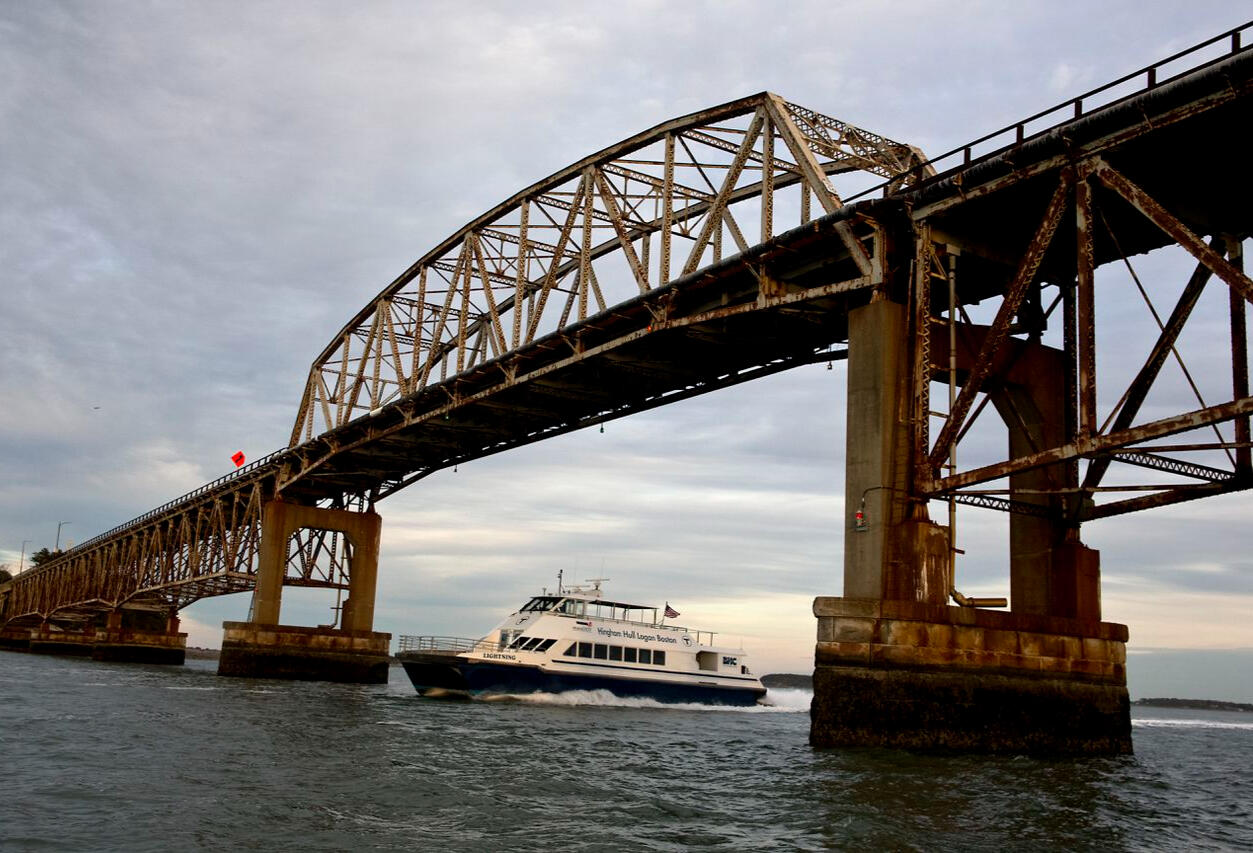
The Supreme Judicial Court has upheld a state decision to allow the project.Our neighborhood has been greatly impacted by the removal of Long Island bridge in 2015. Since then, the City of Boston has overcome many obstacles to gain approval to rebuild. While the end is in sight, it is important that we continue to assist in the process.We ask that you submit letters in support for the last U.S. Coast Guard permit.The navigation determination public comment period on the Long Island Bridge Superstructure Replacement Project is now open, and the USCG will collect public comments through January 6, 2023. Public comment in support of the Long Island Bridge Superstructure Replacement Project is critical.PUBLIC COMMENT SUBMISSION DETAILS:All written public comments must be addressed to the following USCG Official:
Commander
United States Coast Guard
First Coast Guard District
408 Atlantic Avenue
Boston, MA 02110Public comments may be submitted by mail, e-mail at SMB-D1Boston-Bridges-PublicNotices@uscg.mil, or both.
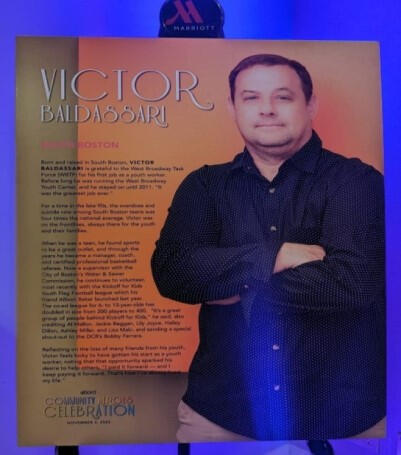
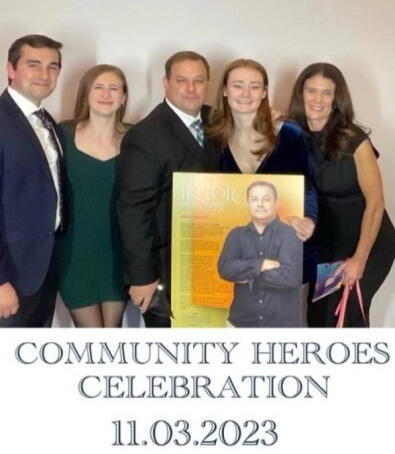
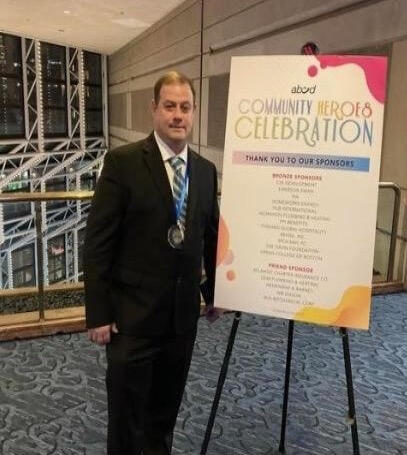
South Boston Community Heroes
VICTOR BALDASSARI
South Boston
Born and raised in South Boston, Victor Baldassari is grateful to the West Broadway Task Force (WBTF) for his first job as a youth worker. Before long he was running the West Broadway Youth Center, and he stayed on until 2011. “It was the greatest job ever.”For a time in the late 90s, the overdose and suicide rate among South Boston teens was four times the national average. Victor was on the frontlines, always there for the youth and their families.When he was a teen, he found sports to be a great outlet, and through the years he became a manager, coach, and certified professional basketball referee. Now a supervisor with the City of Boston’s Water & Sewer Commission, he continues to volunteer, most recently with the Kickoff for Kids Youth Flag Football league which his friend Allison Baker launched last year. The co-ed league for 6- to 13-year-olds has doubled in size from 200 players to 400. “It’s a great group of people behind Kickoff for Kids,” he said, also crediting Al Mallon, Jackie Beggan, Lily Joyce, Hailey Dillon, Ashley Miller, and Lisa Maki, and sending a special shout-out to the DCR’s Bobby Ferrara.Reflecting on the loss of many friends from his youth, Victor feels lucky to have gotten his start as a youth worker, noting that that opportunity sparked his desire to help others. “I paid it forward – and I keep paying it forward. That’s how I’ve always lived my life.”